
The GTM Leader's Guide to Building a Modern Data Validation Infrastructure
Build a robust data validation infrastructure. Learn to implement real-time verification logic for email and phone checks to fuel your revenue engine.
 March 28th, 2026
Stop losing revenue to bad data. Learn how scalable data cleaning frameworks help RevOps and GTM leaders build a reliable pipeline engine.
Your CRM is the engine of your go-to-market strategy. But for most organizations, that engine is underperforming due to one core issue; poor data quality.
Outdated contacts, duplicate records, and incomplete data silently erode pipeline efficiency. The result is wasted SDR effort, declining email deliverability, and unreliable forecasting.
In today’s environment, efficiency is the primary growth lever. GTM leaders can no longer afford to operate on flawed data. Building scalable data cleaning frameworks is no longer optional, it is foundational to revenue performance.
Most organizations approach data cleaning as a periodic task rather than a continuous process.
This reactive model introduces several challenges.
Rapid Data Decay
B2B data changes constantly. Contacts switch roles, companies evolve, and new decision-makers emerge. According to Gartner’s data quality research, poor data quality costs organizations millions annually.
By the time manual cleanup is completed, much of the data is already outdated.
Unscalable Manual Processes
Spreadsheet-based cleaning methods cannot handle large datasets. As databases scale into hundreds of thousands of records, manual processes become inefficient and error-prone.
Limited Data Intelligence
Traditional cleaning focuses on removing errors rather than improving data quality. Basic duplicate removal may occur, but deeper issues such as inconsistent job titles or missing firmographic fields remain unresolved.
Fragmented Data Systems
When different teams maintain separate datasets, inconsistencies emerge. This leads to misaligned messaging, poor targeting, and reduced GTM effectiveness.
These issues collectively weaken pipeline generation and reduce overall efficiency.
Modern GTM teams are moving away from static data cleaning toward continuous data health management.
Platforms like Datakart’s data intelligence platform enable this shift by automating validation, enrichment, and standardization.
Key improvements include:
Continuous Data Validation
Instead of periodic cleaning, data is verified in real time. Changes in roles, companies, and contact details are automatically updated.
Automated Standardization
AI-driven systems apply consistent formatting rules across all records, ensuring uniformity in fields such as job titles, industries, and geographic data.
Enrichment-Driven Improvement
Data quality is enhanced through enrichment rather than just deletion. Missing fields are filled with verified information, improving segmentation and targeting.
Proactive Data Management
Rather than reacting to errors after they occur, modern systems prevent issues before they impact outreach and campaigns.
This approach transforms data from a liability into a strategic advantage.
A successful data cleaning framework requires a structured and continuous approach.
The first step is auditing your current data environment. Metrics such as email bounce rates, duplicate records, and missing fields provide a baseline for improvement.
Next, organizations must define what constitutes a high-quality record. Establishing a “golden record” standard ensures consistency across all data points.
Centralizing data sources is critical. CRM platforms should serve as the single source of truth, with all systems aligned around consistent data inputs.
Automation is the foundation of scalability. Data ingestion, validation, and enrichment should occur automatically through integrated workflows rather than manual intervention.
CTA: Want to see your TAM in action? Try Datakart’s Free Audit.
Governance ensures long-term success. Clear ownership, processes, and standards prevent data degradation over time.
Finally, continuous monitoring enables optimization. Tracking metrics such as data completeness and conversion rates ensures that improvements translate into revenue outcomes.
A mid-sized SaaS company with a large CRM database faced declining SDR productivity and high bounce rates.
Their data contained thousands of duplicate records and missing contact details, limiting outreach effectiveness.
By implementing an automated data cleaning framework, they transformed their GTM operations.
The system consolidated duplicate records, enriched missing data fields, and standardized contact information across the database.
Within one quarter:
• Email deliverability improved significantly
• SDR connect rates increased
• Time spent on manual data tasks decreased
• Pipeline generation improved without increasing headcount
The results demonstrated that improving data quality directly impacts revenue outcomes.
Several common pitfalls can undermine data cleaning efforts.
Treating data cleaning as a one-time project leads to recurring data decay. Continuous processes are required for sustained accuracy.
Focusing only on deletion limits value. Enrichment and standardization are equally important for improving data quality.
Lack of governance allows inconsistencies to re-enter the system. Clear ownership and processes are essential.
Ignoring user adoption reduces effectiveness. Sales and marketing teams must trust and consistently use the data within CRM systems.
A modern GTM stack includes three critical layers.
CRM platforms act as the system of record, storing account and contact data.
Marketing and sales tools execute campaigns and outreach.
The intelligence layer ensures data quality.
Platforms like Datakart’s real-time enrichment platform continuously validate and enrich data, ensuring that all downstream systems operate with accurate information.
Organizations evaluating data infrastructure often explore Datakart’s pricing and enrichment options to determine how scalable data cleaning frameworks fit into their GTM strategy.
Data quality is a direct driver of GTM performance.
Scalable data cleaning frameworks enable organizations to move from reactive data management to proactive data intelligence.
By automating validation, enrichment, and governance, teams can operate with accurate, reliable data across every GTM motion.
The result is improved efficiency, stronger pipeline generation, and more predictable revenue growth.
Ready to improve your data quality and unlock hidden pipeline potential?
Book a 30-minute demo with the Datakart team to see how automated data cleaning frameworks can transform your GTM strategy.
What is a data cleaning framework?
A data cleaning framework is a structured system for continuously identifying, correcting, and enriching data to maintain accuracy and consistency across systems.
How do you automate data cleaning?
Automation involves integrating data platforms with CRM systems to perform validation, enrichment, and standardization in real time.
What defines high-quality GTM data?
High-quality data is accurate, complete, consistent, up-to-date, and free from duplicates.
How often should data cleaning occur?
Modern data cleaning should be continuous rather than periodic, ensuring data remains accurate as it changes over time.
Build a robust data validation infrastructure. Learn to implement real-time verification logic for email and phone checks to fuel your revenue engine.
March 28th, 2026
Stop wasting budget on stale data. Learn a step-by-step framework for account list creation using tech, hiring, and social signals for a high-precision GTM strategy.
March 28th, 2026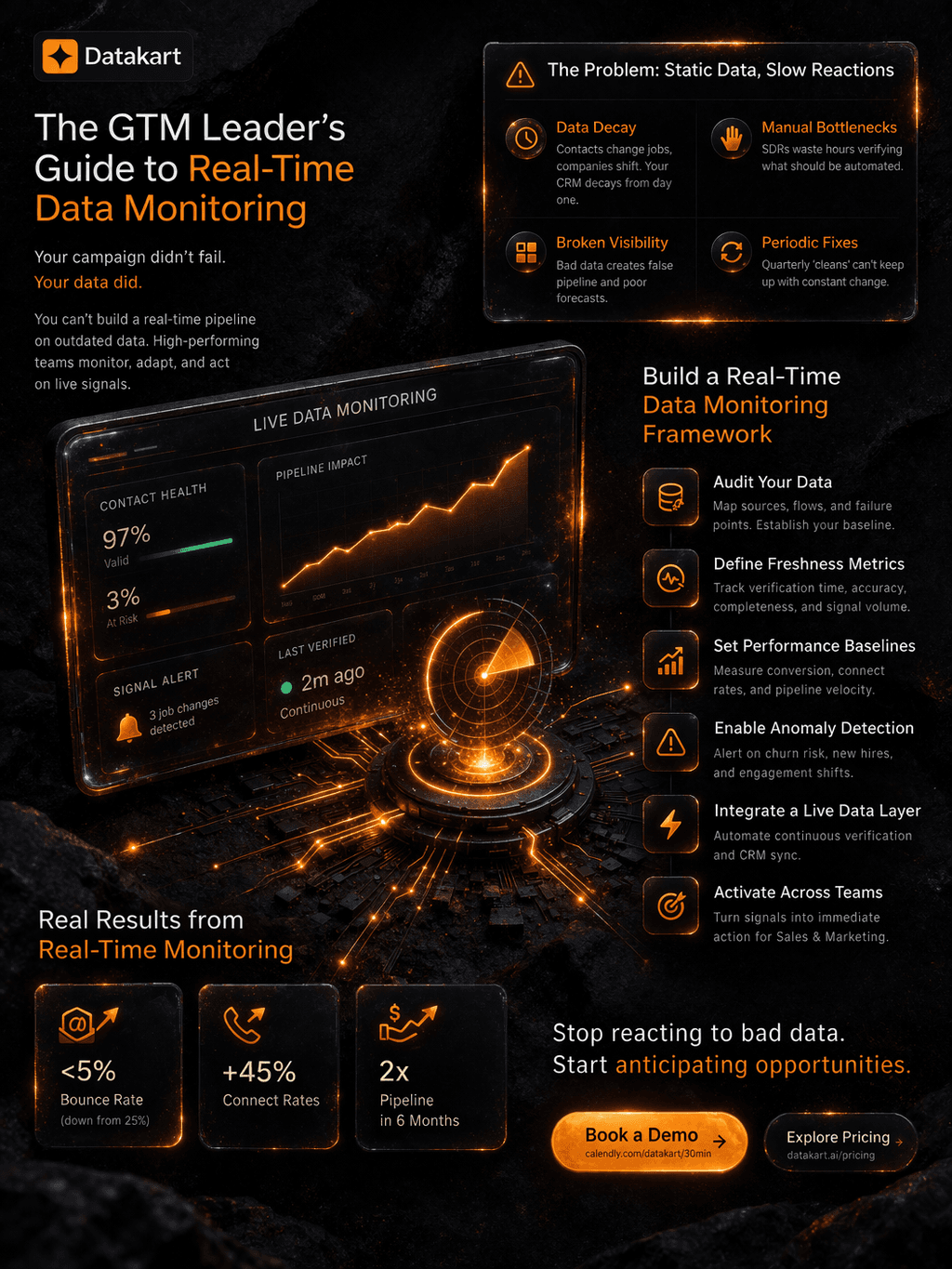
Stale data is killing your pipeline. Learn how GTM leaders use real-time data monitoring and anomaly detection to boost data freshness and pipeline visibility.
March 25th, 2026