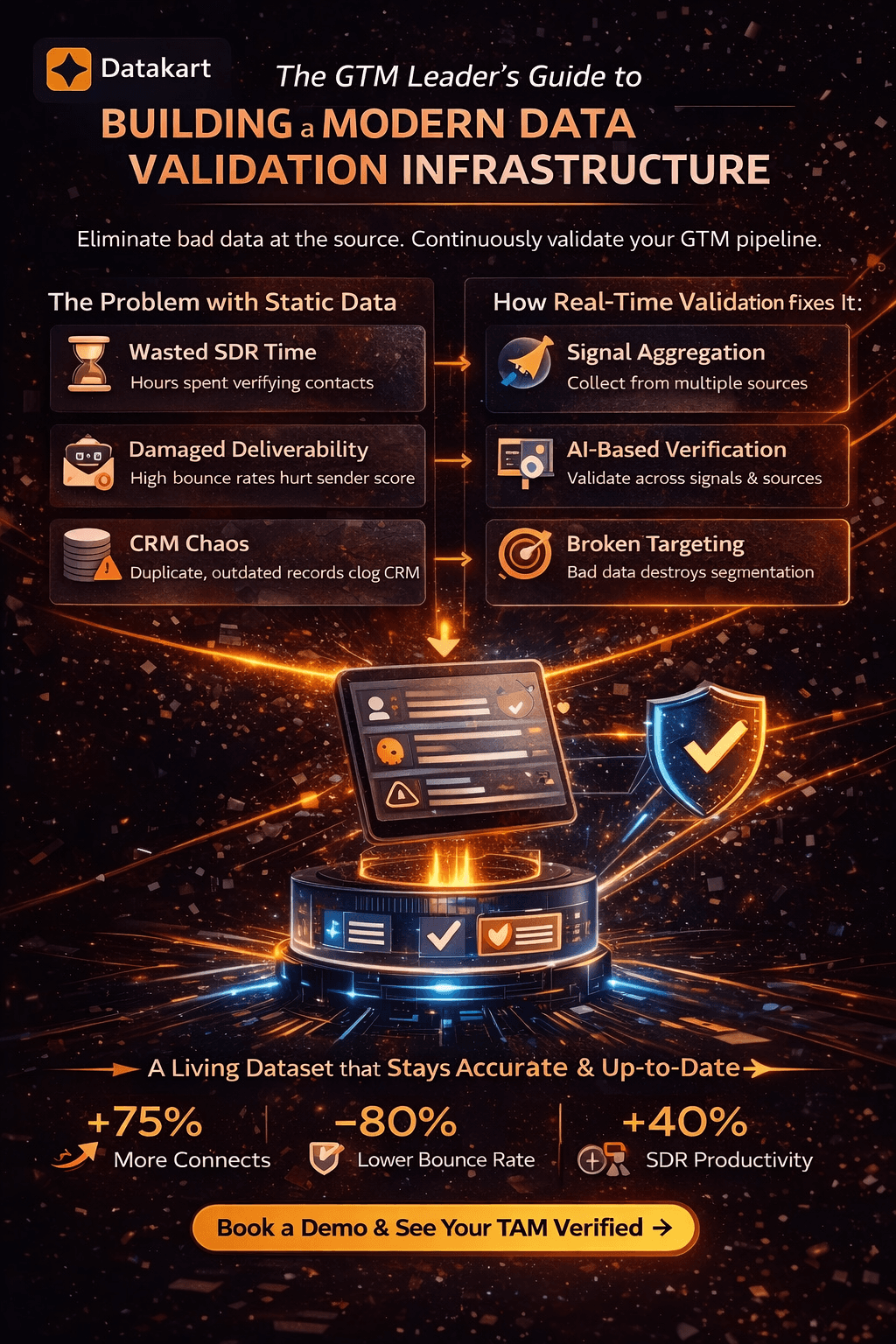
The GTM Leader's Guide to Building a Modern Data Validation Infrastructure
Build a robust data validation infrastructure. Learn to implement real-time verification logic for email and phone checks to fuel your revenue engine.
 March 28th, 2026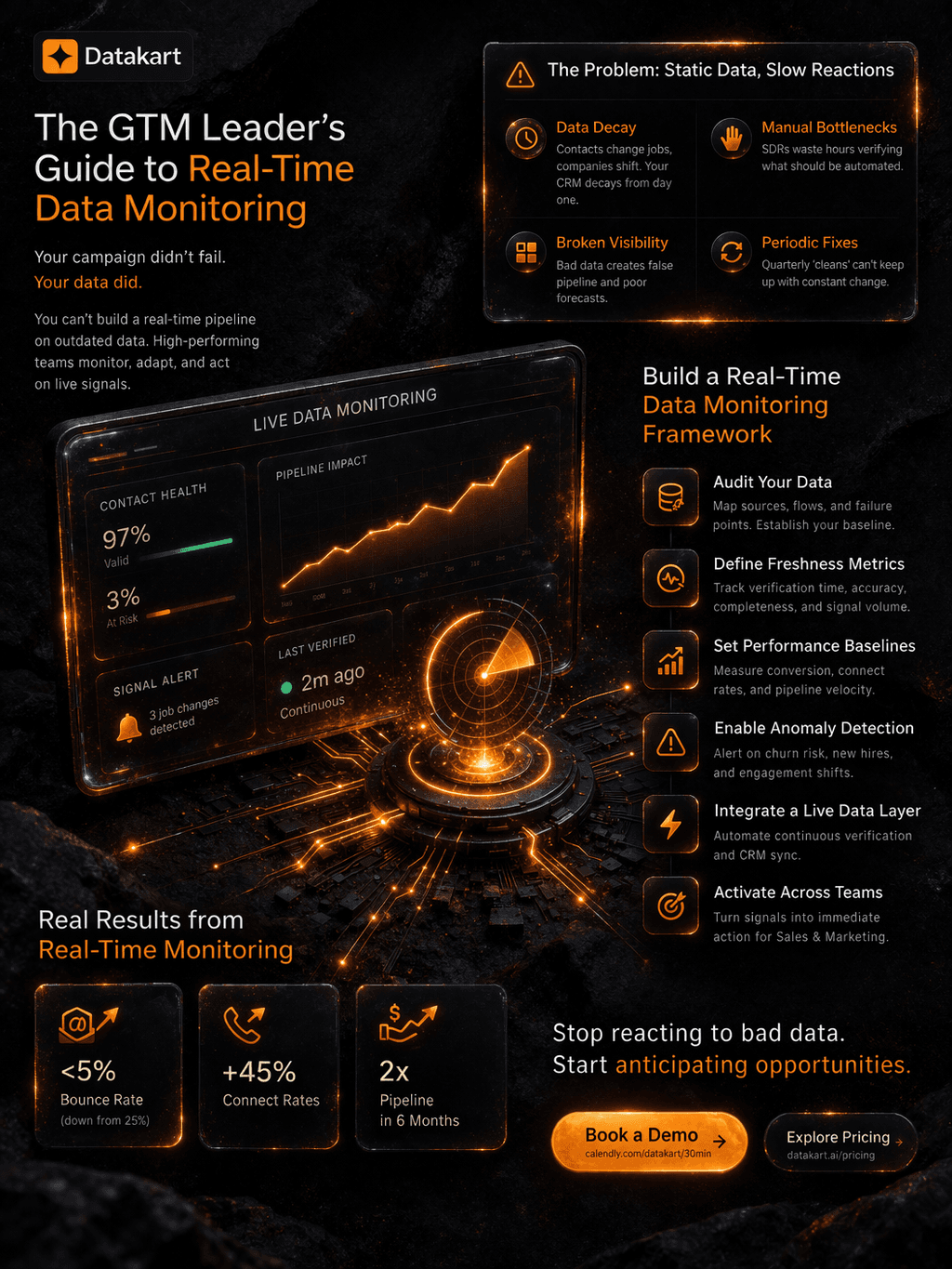
Stale data is killing your pipeline. Learn how GTM leaders use real-time data monitoring and anomaly detection to boost data freshness and pipeline visibility.
Your campaign didn’t fail. Your data did.
You launched with confidence. Targeting was dialed in, messaging was sharp, and execution was aligned.
Then reality hit quickly; high bounce rates, missed connects, and outdated contacts.
Within days, your projected pipeline begins to slip.
This is not an exception. It is the default outcome when GTM teams operate on static data.
The underlying truth is simple.
You cannot build a real-time pipeline on outdated data.
This is where real-time data monitoring becomes a core GTM capability rather than an optional enhancement.
Most GTM teams still operate using workflows designed for a slower environment.
Data is cleaned periodically. Lists are enriched quarterly. Issues are addressed only after they surface.
This model no longer works.
Data Decay Is Continuous
Contacts change roles, companies evolve, and signals shift constantly.
Your CRM begins to decay the moment new data enters the system.
Manual Processes Do Not Scale
Verification handled by SDRs or operations teams introduces bottlenecks.
It is costly, inconsistent, and reactive.
Pipeline Visibility Becomes Distorted
If the underlying data is inaccurate, pipeline metrics cannot be trusted.
Forecasting becomes unreliable, and decision-making slows down.
Refresh Cycles Create False Confidence
A database that appears clean today will be outdated tomorrow.
Periodic updates cannot keep pace with continuous data change.
This creates a critical gap between perceived pipeline health and actual performance.
High-performing GTM teams do not simply manage data. They monitor it continuously.
They transition from static records to dynamic data systems that update in real time.
Platforms like Datakart’s GTM intelligence platform enable this shift by transforming data into a live intelligence layer.
Key capabilities include:
Continuous Verification
Every contact and account is validated across multiple sources on an ongoing basis.
Real-Time Updates
Changes such as job moves, company events, and behavioral signals are captured as they happen.
Anomaly Detection
The system identifies unusual patterns that indicate risk or opportunity, enabling proactive action.
Instead of reacting to broken data, teams anticipate change and act ahead of it.
Implementing real-time data monitoring requires a structured approach grounded in measurable outcomes.
The process begins with auditing your current data ecosystem. Identify all data sources, understand how data flows between systems, and pinpoint failure points such as duplicates, missing fields, or decay.
Quantify the impact by analyzing metrics such as bounce rates, invalid contacts, and misrouted leads.
Next, define data freshness metrics. These include last verified timestamps, contact accuracy rates, field completeness, and signal detection volume. These metrics must be tracked continuously rather than periodically.
Establish pipeline baselines before implementing improvements. Track conversion rates, connect rates, sales cycle length, and pipeline velocity to create a clear benchmark for progress.
CTA: Want to see your TAM in action? Try Datakart’s Free Audit.
Anomaly detection should then be implemented to identify meaningful changes. Alerts should capture events such as key contacts leaving accounts, new hires in target roles, sudden engagement drops, or shifts in account activity patterns. These events represent actionable signals rather than passive data updates.
A real-time data layer must be integrated into your GTM stack. This layer continuously verifies and enriches data while pushing updates directly into your CRM, ensuring all systems operate on current information.
Finally, signals must be activated across teams. Sales and marketing should respond to triggers such as job changes, hiring activity, or engagement spikes with timely and relevant outreach. This converts data into measurable revenue outcomes.
Consider a SaaS company facing low connect rates and extended sales cycles.
Before implementing real-time monitoring, the organization experienced high email bounce rates, significant time spent on manual research, and limited pipeline visibility.
After adopting a real-time data system, continuous verification was introduced, signal-based alerts were activated, and the CRM was synchronized with live data updates.
The results were substantial.
• Email bounce rates dropped below five percent
• Connect rates increased by 45 percent
• Sales cycles shortened by 30 percent
• Pipeline doubled within six months
The improvement did not come from increased effort. It came from eliminating friction within the data system.
Several common mistakes reduce the effectiveness of real-time data monitoring strategies.
Treating monitoring as a one-time initiative leads to rapid degradation. Data must be continuously monitored and updated.
Insufficient integration depth creates manual work. Systems must update automatically to maintain efficiency.
Focusing solely on data accuracy overlooks the importance of behavioral signals. Signals are critical for identifying opportunities.
Lack of alignment across sales, marketing, and RevOps teams reduces impact. All teams must operate from the same data framework.
A modern GTM monitoring stack is composed of three key layers.
CRM systems such as Salesforce or HubSpot function as the system of record.
The intelligence layer powers monitoring and validation.
Platforms like Datakart’s data intelligence platform continuously verify data, enrich records, and detect meaningful signals.
Execution tools such as sales engagement and marketing automation platforms activate this intelligence.
Organizations evaluating this approach often explore Datakart’s pricing and enrichment plans to understand how real-time monitoring integrates into their GTM strategy.
The underlying principle is clear: real-time data enables faster action and better outcomes.
Most GTM teams treat data as a maintenance task.
High-performing teams treat it as a strategic advantage.
Real-time data monitoring enables continuous accuracy, earlier opportunity detection, reduced wasted effort, and more predictable pipeline performance.
This shift transforms GTM execution from reactive to proactive.
It is the difference between operating on assumptions and operating on live intelligence.
Ready to stop operating with outdated data?
Discover how real-time monitoring can transform your pipeline. Book a 30-minute demo with the Datakart team or explore Datakart’s pricing and enrichment plans to get started.
What is real-time data monitoring in GTM?
Real-time data monitoring is the continuous process of verifying, updating, and tracking changes in contact and account data to ensure accuracy and relevance.
What is anomaly detection in GTM?
Anomaly detection identifies unusual or important changes, such as job moves or engagement shifts, that indicate potential buying opportunities.
Why does data freshness matter?
Fresh data ensures outreach reaches the right person at the right time, improving conversion rates and overall efficiency.
Can this integrate with my CRM?
Yes, platforms like Datakart integrate directly with CRMs to provide real-time updates and maintain a consistent and reliable source of truth.
Build a robust data validation infrastructure. Learn to implement real-time verification logic for email and phone checks to fuel your revenue engine.
March 28th, 2026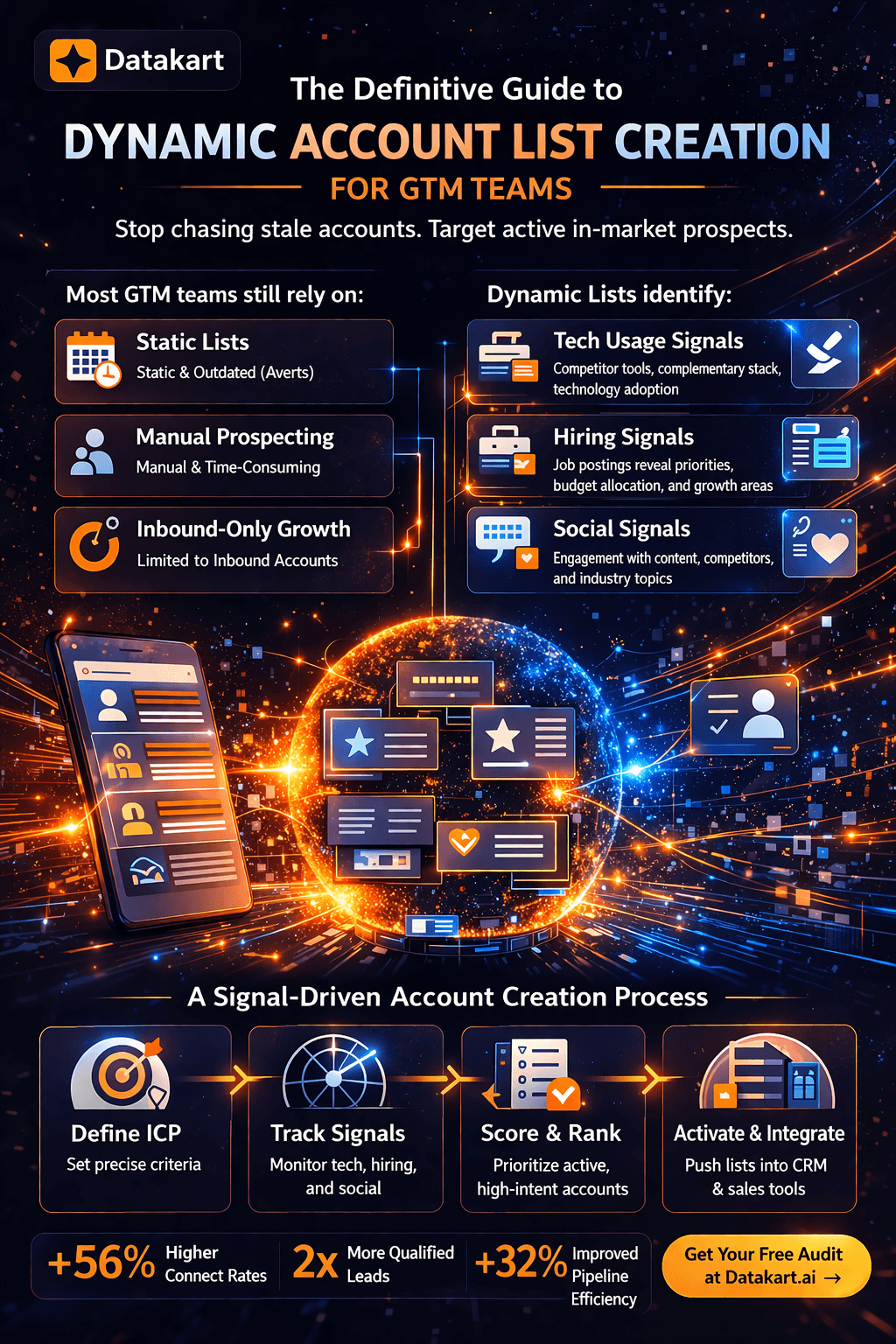
Stop wasting budget on stale data. Learn a step-by-step framework for account list creation using tech, hiring, and social signals for a high-precision GTM strategy.
March 28th, 2026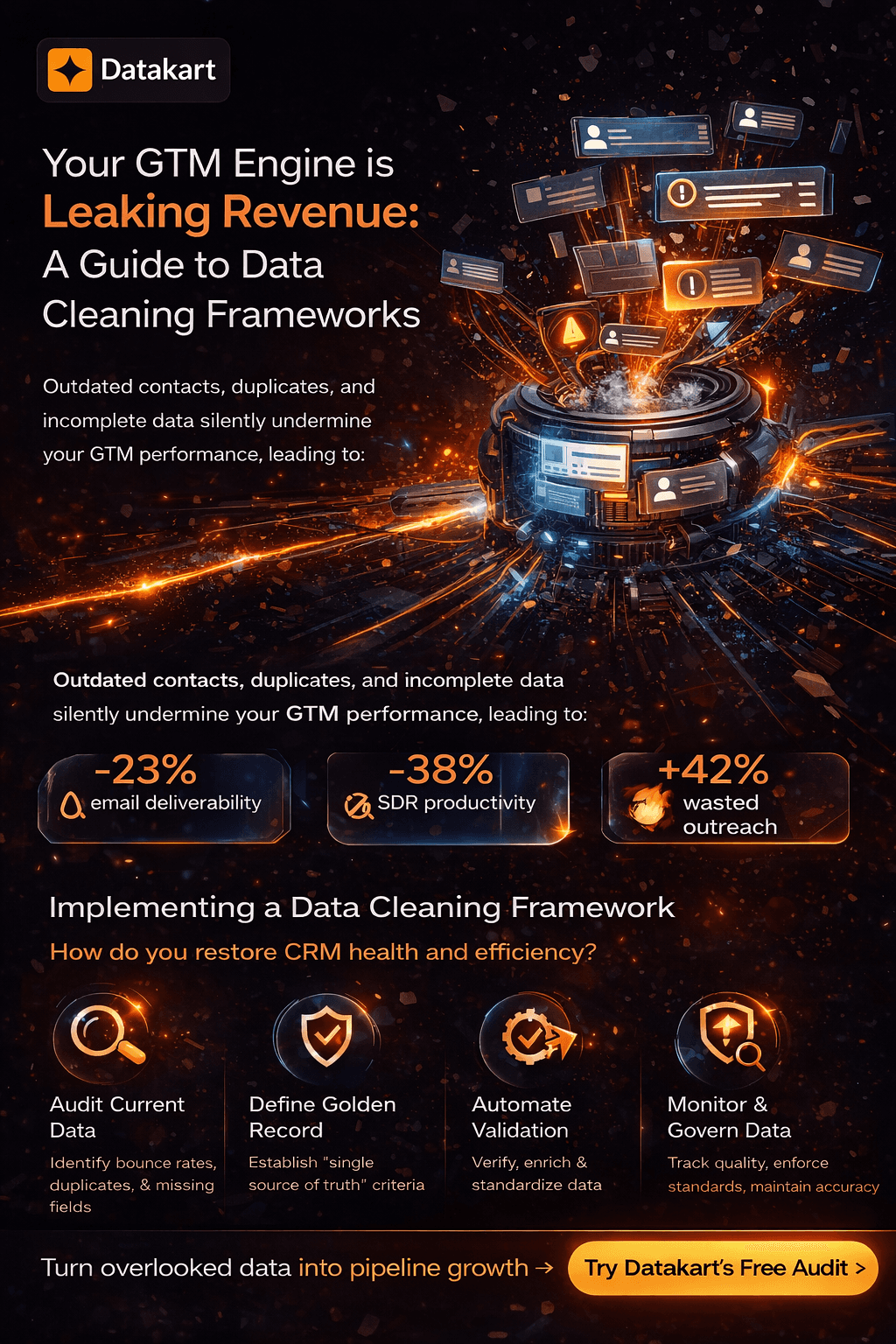
Stop losing revenue to bad data. Learn how scalable data cleaning frameworks help RevOps and GTM leaders build a reliable pipeline engine.
March 21st, 2026