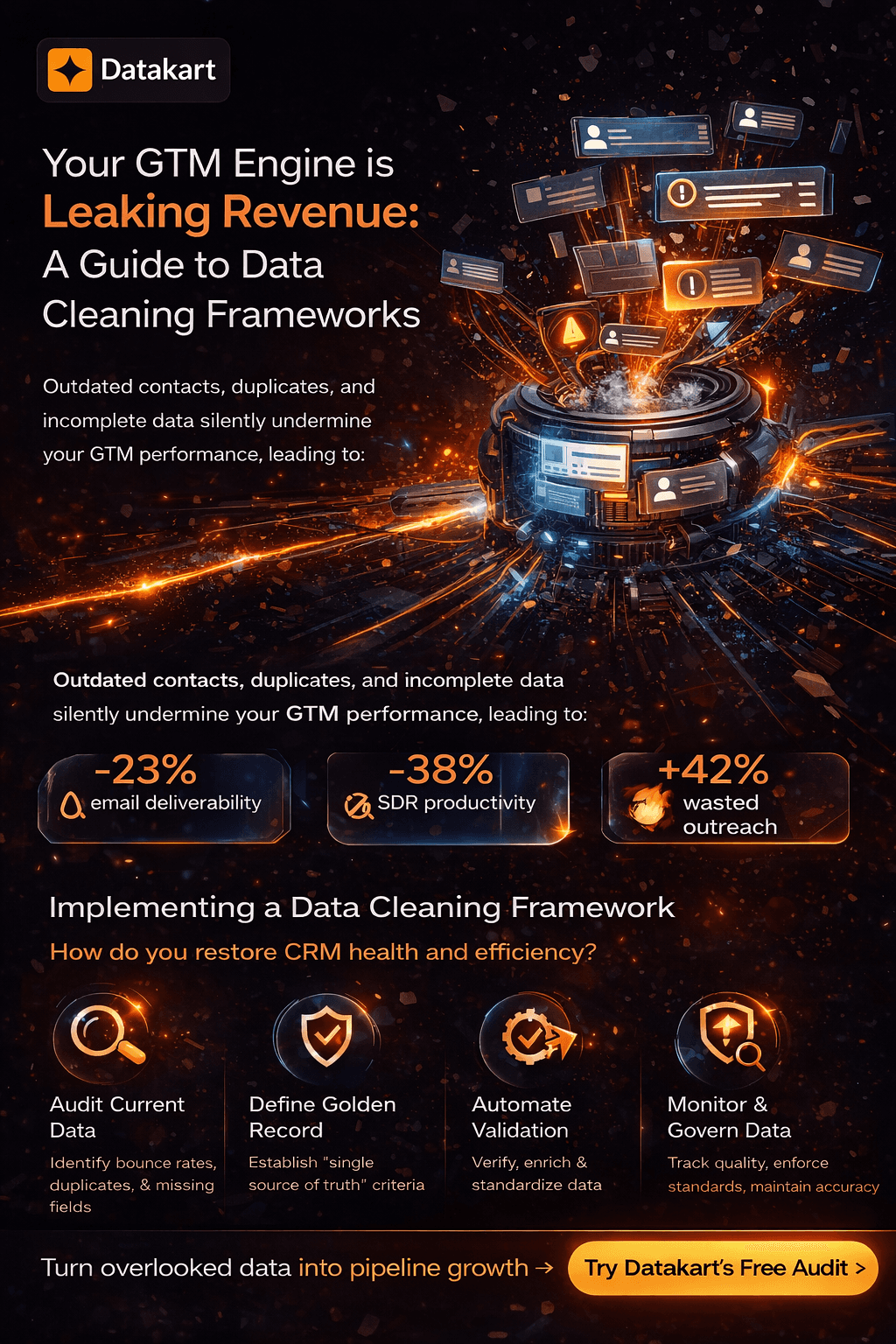
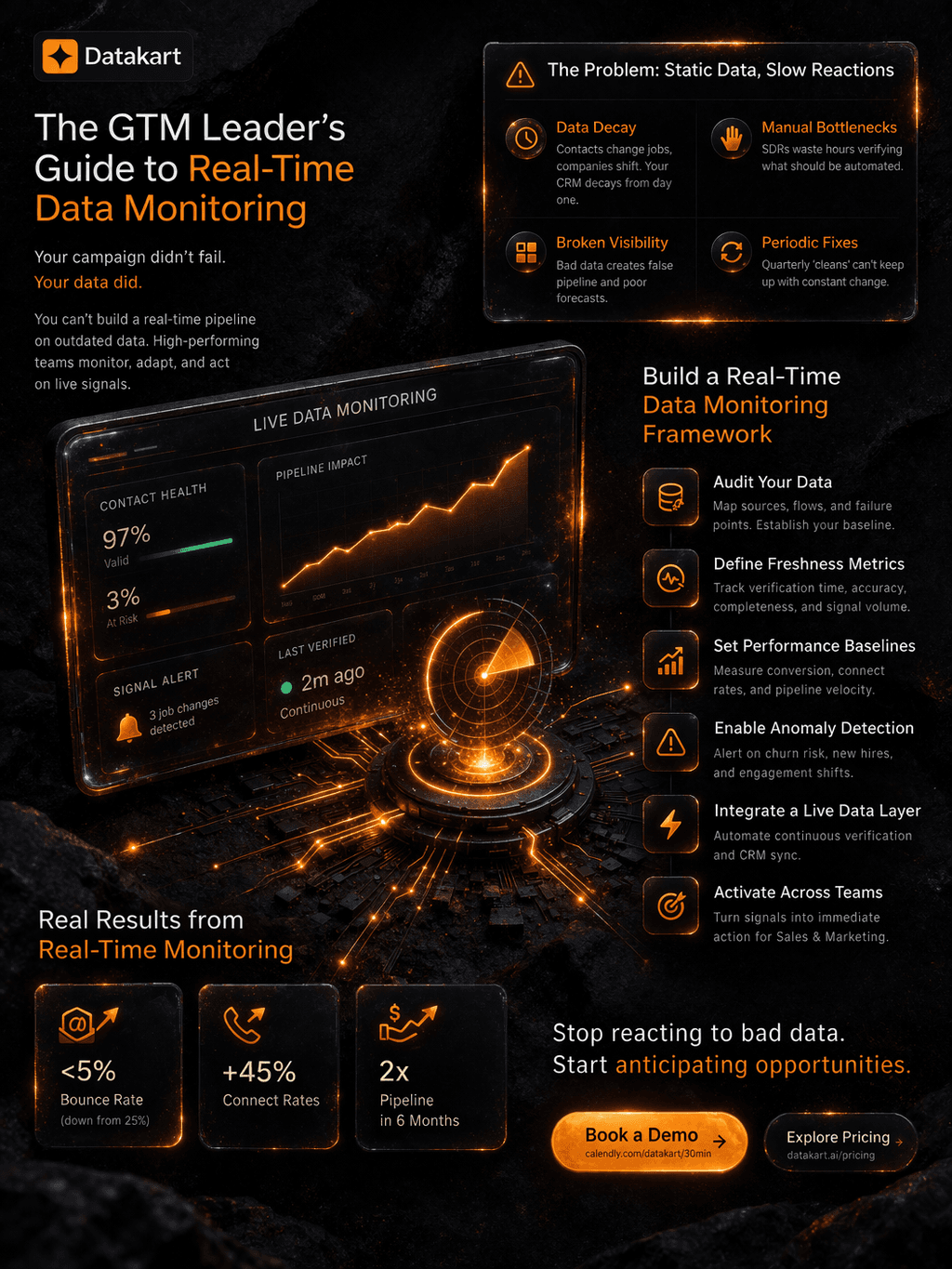
The GTM Leader's Guide to Building a Modern Data Validation Infrastructure
Your GTM engine runs on data.
But most teams are running on bad fuel.
Disconnected numbers. Bounced emails. Outdated contacts.
And the result is predictable.
Wasted SDR effort. Broken campaigns. Unreliable pipeline.
The problem isn’t lack of data.
It’s lack of validation.
Without a strong validation infrastructure, your data decays faster than your team can use it.
The Problem with Traditional Data Methods
Most GTM teams still rely on a point-in-time approach.
Buy a list. Upload it. Start outreach.
The issue?
Data starts decaying immediately.
People change roles. Companies evolve. Systems update.
Within months, a significant portion of your database becomes unreliable.
And the impact compounds quickly.
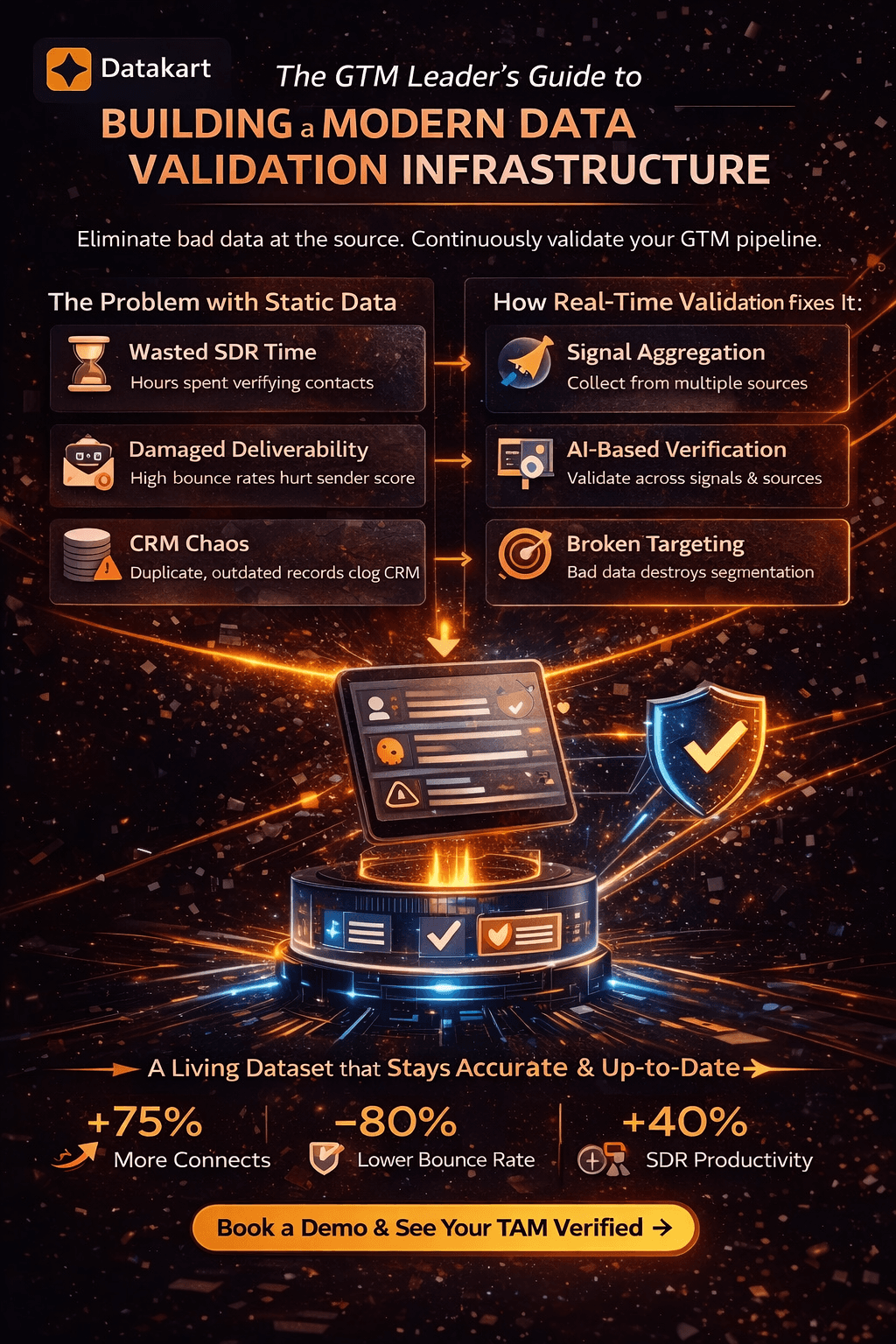
Wasted SDR Time
Reps spend hours verifying data instead of selling.
Every wrong number reduces productivity and morale.
Damaged Deliverability
High email bounce rates hurt your sender reputation.
Eventually, even valid emails stop landing in inboxes.
Broken Targeting
Bad data leads to poor segmentation.
Your campaigns reach the wrong people or no one at all.
CRM Becomes Unusable
Duplicate, outdated, and incomplete records clutter your system of record.
Automation breaks. Reporting becomes unreliable.
Manual cleanup won’t fix this.
It only delays the next failure.
How Modern Validation Infrastructure Solves This
The solution is not better lists.
It’s a better system.
A modern validation infrastructure shifts your approach from static to dynamic.
Instead of asking:
“Was this data correct when we got it?”
You ask:
“Is this data correct right now?”
This is enabled through layered, real-time verification.
Signal Aggregation
Data is continuously collected from multiple sources.
Job changes. company updates. tech stack changes.
These signals provide context.
AI-Based Verification
Information is cross-checked across sources.
Not just matching fields but validating accuracy through multiple signals.
Real-Time Checks
Every time data is used, it is verified.
• Email checks confirm deliverability
• Phone checks confirm active numbers
• Company data is validated
This creates a living dataset.
Instead of decaying, it continuously updates.
A Practical Framework for Building Validation Infrastructure
To implement this effectively, you need a structured approach.
Start by auditing your data flow.
Identify where data enters your systems; forms, imports, integrations.
Define your minimum data standard.
Establish non-negotiable fields like verified email, phone, and accurate company data.
Build multi-layer verification logic.
Include email validation, phone verification, and company-level checks.
Centralize validation.
Use a single system like Datakart.ai to act as your data gatekeeper.
CTA: Want to see your TAM in action?
Try Datakart’s Free Audit.
Integrate validation into your GTM stack.
Ensure real-time checks happen inside your CRM and marketing systems.
Automate cleansing and enrichment.
Continuously clean existing data and enrich records with missing fields.
Create a feedback loop.
Allow sales teams to flag bad data and improve validation over time.
Real-World Impact: From Data Chaos to Revenue Efficiency
A SaaS company with a 20-person SDR team struggled with poor data quality.
Low connect rates. High bounce rates. Manual verification.
They implemented a centralized validation system.
First, they audited their CRM.
Thousands of invalid emails and outdated numbers were identified and removed.
Then, they introduced real-time validation.
Every new lead was verified before entering the system.
Finally, they enriched high-value accounts with verified contact data.
The results were clear.
• Email bounce rates dropped significantly
• Connect rates increased by over 25%
• SDRs saved hours each week
They didn’t change strategy.
They fixed their data foundation.
Common Mistakes to Avoid
Treating validation as a one-time cleanup leads to rapid decay. Validation must be continuous.
Relying on a single data source reduces accuracy. Multiple data inputs improve reliability.
Ignoring phone validation limits outbound effectiveness. Multi-channel requires full verification.
Lack of ownership leads to inconsistent data quality. Clear governance is essential.
Failing to drive adoption reduces impact. Teams must trust and use validated data.
Tools and Best Practices
Your validation infrastructure should sit at the core of your GTM stack.
Your CRM remains your system of record.
Your engagement tools execute outreach.
Your data platform ensures accuracy.
Platforms like Datakart.ai act as the validation and enrichment layer.
They verify, clean, and update data before it reaches your team.
This ensures every action is based on reliable information.
You can explore how this fits into your GTM investment through Datakart pricing.
Conclusion
Your data is not just an input.
It’s a strategic asset.
And without validation, it becomes a liability.
A strong validation infrastructure transforms your GTM engine.
It eliminates wasted effort.
Improves efficiency.
And creates a foundation for predictable growth.
The teams that win aren’t the ones with the most data.
They’re the ones with the most accurate data.
Ready to fix your data foundation?
Book a 30-minute demo: https://calendly.com/datakart/30min
Frequently Asked Questions
What is a data validation infrastructure?
It is a system that continuously verifies the accuracy of contact and company data through automated checks.
How is validation different from enrichment?
Validation ensures data is correct. Enrichment adds missing data to make records more complete.
Why is real-time validation important?
Because data changes constantly. Real-time validation ensures accuracy at the moment of use.
Can validation integrate with existing tools?
Yes, platforms like Datakart integrate with CRMs and marketing tools to enable seamless validation workflows.
What ROI can you expect from validation infrastructure?
Improved connect rates, lower bounce rates, increased SDR productivity, and more reliable pipeline performance.

 March 28th, 2026