
The GTM Leader's Guide to Building a Modern Data Validation Infrastructure
Build a robust data validation infrastructure. Learn to implement real-time verification logic for email and phone checks to fuel your revenue engine.
 March 28th, 2026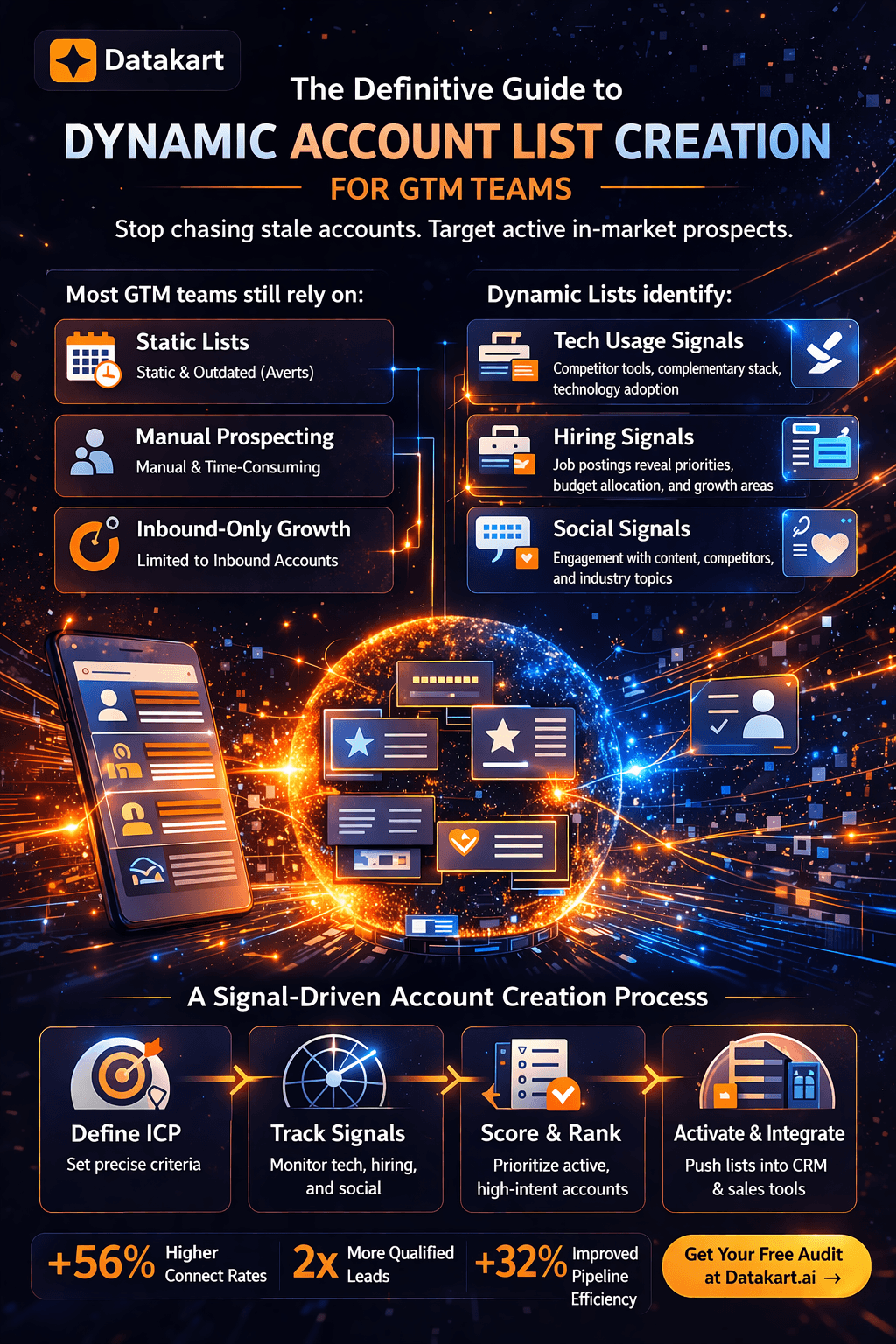
Stop wasting budget on stale data. Learn a step-by-step framework for account list creation using tech, hiring, and social signals for a high-precision GTM strategy.
Your GTM strategy is only as strong as the accounts you target.
But most teams are still working from static lists that decay the moment they are created.
The result is predictable.
Wasted ad spend, low connect rates, and SDRs chasing the wrong accounts.
A Total Addressable Market that exists in theory but not in execution.
The problem is not volume.
It is precision.
Modern account list creation is not about building larger lists.
It is about identifying the small fraction of accounts that are actively in-market right now.
Most GTM teams still rely on outdated methods.
And those methods are fundamentally broken.
Static Lists Decay Instantly
Lists are built on firmographic filters.
By the time they are uploaded into your CRM, they are already outdated.
Contacts move, companies evolve, and priorities shift.
You are working with stale data from the beginning.
Manual Prospecting Does Not Scale
SDRs spend hours building lists manually.
This process is slow, inconsistent, and takes time away from selling.
It is effort-heavy and delivers minimal impact.
Inbound-Only Strategies Limit Growth
Inbound channels are valuable but inherently reactive.
You are waiting for buyers to discover you.
This means missing a significant portion of your addressable market.
All three approaches share the same core issue.
They rely on historical data rather than real-time signals.
And that means you are always late to the opportunity.
The shift is clear.
From static lists to dynamic intelligence.
Instead of asking who fits your ICP, you ask who fits your ICP and is demonstrating buying intent right now.
This is where modern account list creation evolves into a signal-driven approach.
Technology Signals Reveal Context
Technology usage provides insight into what an account is doing.
• Using a competitor
• Adopting complementary tools
• Expanding their technology stack
These signals create immediate entry points for relevant outreach.
Hiring Signals Reveal Priorities
Hiring activity is one of the strongest indicators of intent.
Companies hire to solve problems.
• Hiring SDR leaders signals outbound expansion
• Hiring data engineers indicates investment in data infrastructure
• Hiring finance operations roles reflects process optimization
These signals reveal budget allocation, urgency, and direction.
Social Engagement Reveals Interest
What decision-makers engage with indicates what they care about.
• Following industry topics
• Engaging with competitor content
• Sharing relevant insights
These behaviors provide real-time indicators of interest.
When combined, these signals transform your TAM into a live pipeline of in-market accounts.
This is the intelligence layer platforms like Datakart’s GTM intelligence platform provide.
Effective account list creation requires a structured, signal-driven approach.
The process begins by redefining your Ideal Customer Profile. Move beyond static attributes and incorporate behavioral and operational signals that define your best customers.
Next, layer in technology signals. Understanding which tools your ideal accounts use helps identify integration opportunities, competitive positioning, and maturity levels.
Hiring signals should then be tracked. Job postings provide clear insight into where companies are investing and which challenges they are trying to solve.
Social engagement data adds another layer of context. Monitoring how accounts interact with relevant topics, content, and competitors reveals early-stage interest.
CTA: Want to see your TAM in action? Try Datakart’s Free Audit.
With these inputs, prioritization should be automated. Scoring models that combine multiple signals ensure that accounts are ranked based on real buying intent rather than static fit.
This intelligence must then be integrated into your GTM stack. Dynamic account lists should flow directly into your CRM and sales engagement platforms for immediate execution.
Finally, teams must be enabled with context. Sales representatives should not only know who to contact, but also understand why the timing is relevant.
A FinTech SaaS company selling accounts payable automation struggled with low connect rates.
Their targeting strategy relied on broad firmographic filters such as company size and industry.
After adopting a dynamic account list creation approach, they refined their targeting using multiple signals.
These included companies using NetSuite or QuickBooks, hiring for accounts payable and finance roles, and engaging with content related to financial operations.
Instead of cold outreach, SDRs now had clear context for engagement.
They could initiate conversations with relevance, referencing hiring activity and existing systems.
The results were significant.
• Meeting rates increased by over 100 percent
• Conversations became more meaningful
• Pipeline quality improved
The company did not increase effort.
It improved targeting precision.
Relying on a single signal reduces accuracy. True intent emerges from combining multiple signals.
Treating account list creation as a one-time activity leads to rapid decay. Lists must be continuously updated.
Ignoring data quality introduces noise. Verification is essential for reliable targeting.
Misalignment between marketing and sales disrupts execution. Both teams must operate from shared definitions and data sources.
A modern GTM stack operates across three core layers.
The CRM serves as the system of record.
Engagement tools execute outreach and campaigns.
The intelligence layer powers both.
Platforms like Datakart’s data intelligence platform aggregate signals, verify data, and prioritize accounts automatically.
Organizations evaluating this approach often explore Datakart’s pricing and enrichment plans to understand how dynamic data integrates into their GTM strategy.
The result is a system where teams consistently act on accurate and actionable insights.
Static lists are a liability.
Dynamic account lists are a competitive advantage.
The shift from firmographics to real-time signals transforms how GTM teams operate.
Instead of guessing, you act with clarity.
Instead of chasing, you engage at the right moment.
This is how modern GTM teams build predictable pipeline and drive consistent growth.
Ready to build a smarter pipeline?
Discover how dynamic data can transform your targeting strategy. Book a 30-minute demo with the Datakart team and uncover the highest-value accounts in your market.
What are buying signals in account list creation?
Buying signals are indicators that a company is actively in a purchase cycle. These include technology adoption, hiring activity, and social engagement.
How often should account lists be updated?
Dynamic account lists should be refreshed continuously, ideally in real time or at least on a weekly basis.
How does AI improve account list accuracy?
AI processes large datasets, identifies behavioral patterns, and scores accounts based on multiple signals to prioritize high-intent opportunities.
Does this approach work for both ABM and outbound?
Yes. It enables precise account selection for ABM strategies and prioritization for large-scale outbound efforts.
What is the difference between intent data and hiring signals?
Intent data reflects research behavior, while hiring signals indicate internal investment and operational priorities. Combining both creates stronger intent signals.
Build a robust data validation infrastructure. Learn to implement real-time verification logic for email and phone checks to fuel your revenue engine.
March 28th, 2026
Stop losing revenue to bad data. Learn how scalable data cleaning frameworks help RevOps and GTM leaders build a reliable pipeline engine.
March 21st, 2026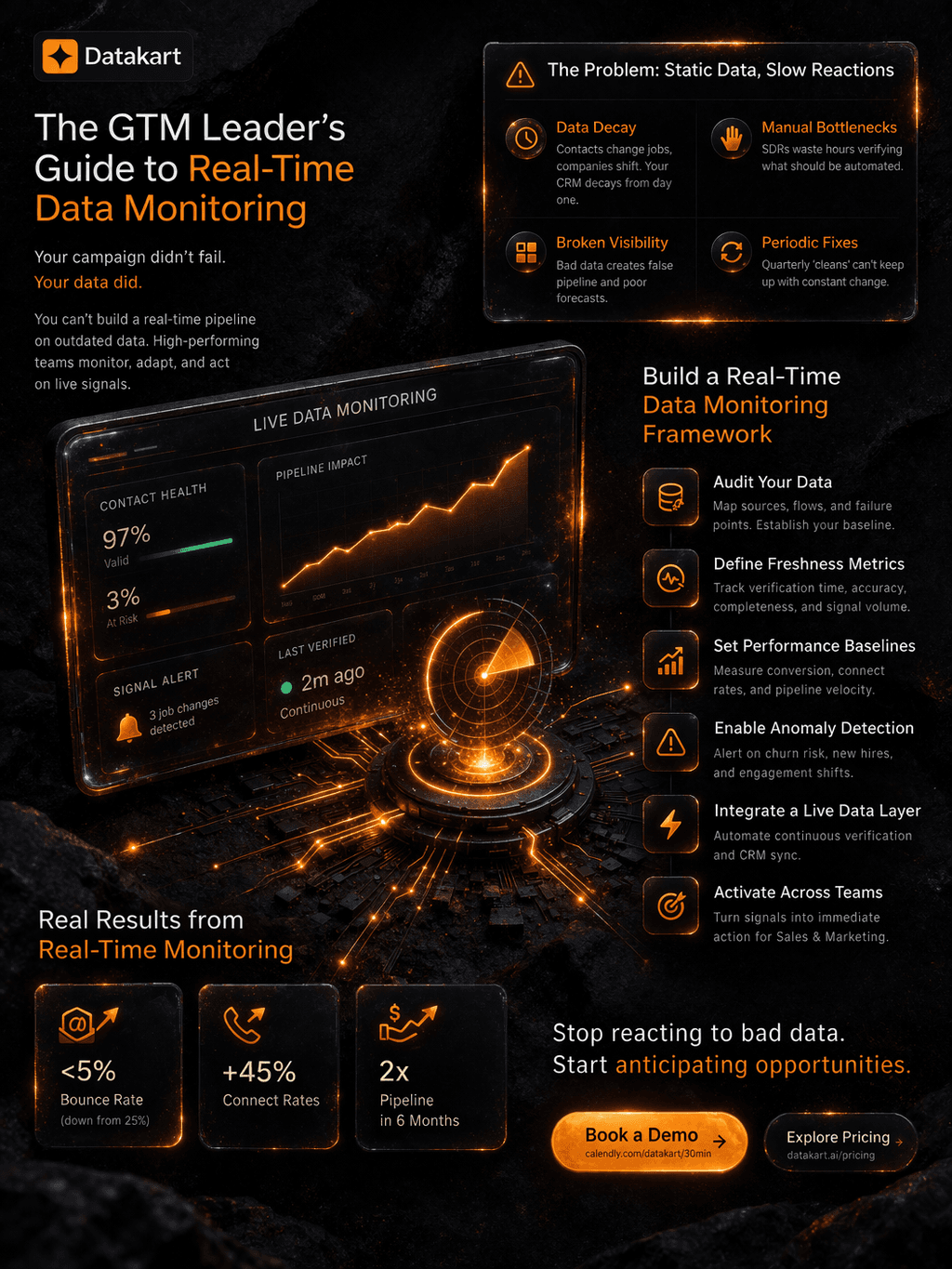
Stale data is killing your pipeline. Learn how GTM leaders use real-time data monitoring and anomaly detection to boost data freshness and pipeline visibility.
March 25th, 2026