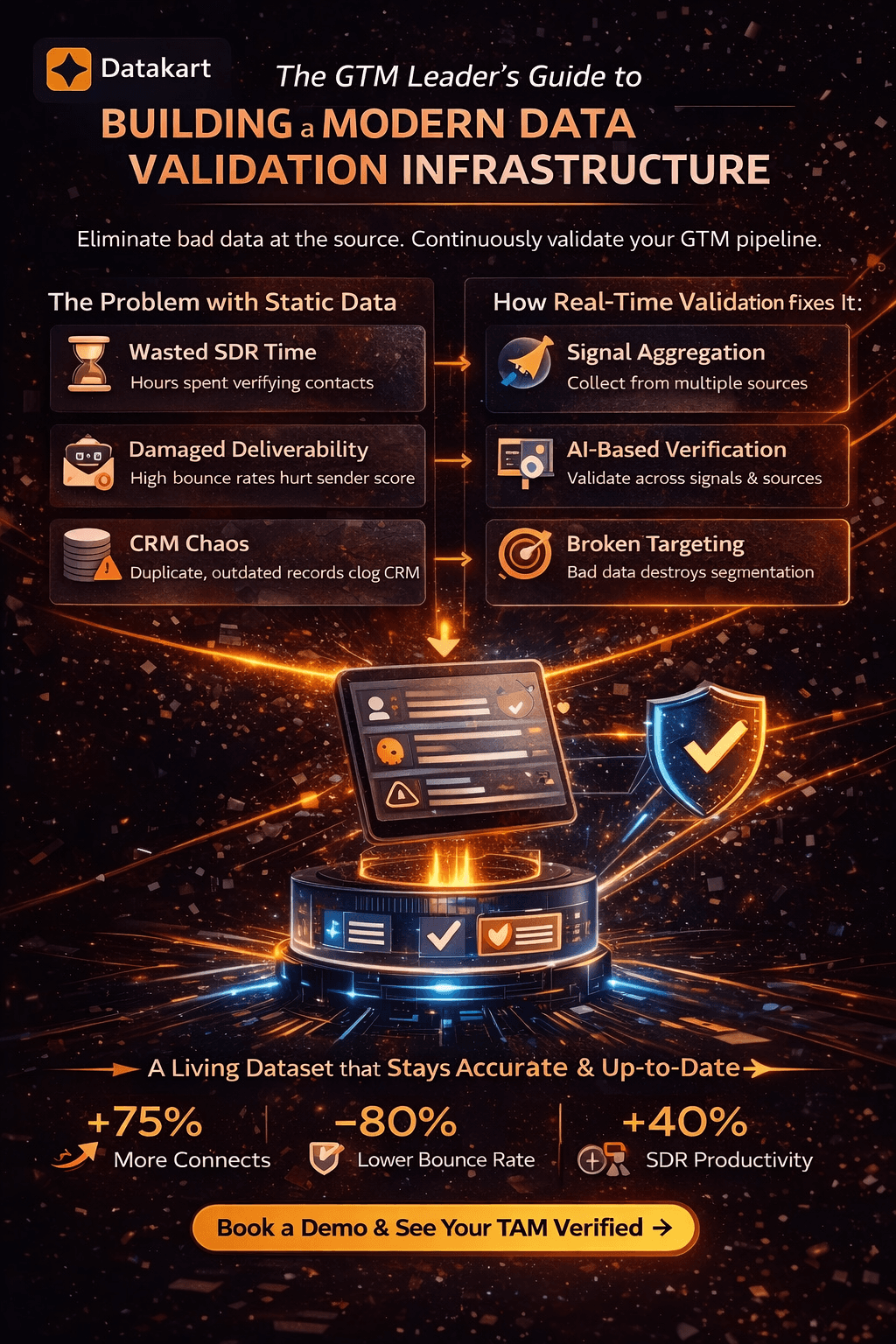
The GTM Leader's Guide to Building a Modern Data Validation Infrastructure
Build a robust data validation infrastructure. Learn to implement real-time verification logic for email and phone checks to fuel your revenue engine.
 March 28th, 2026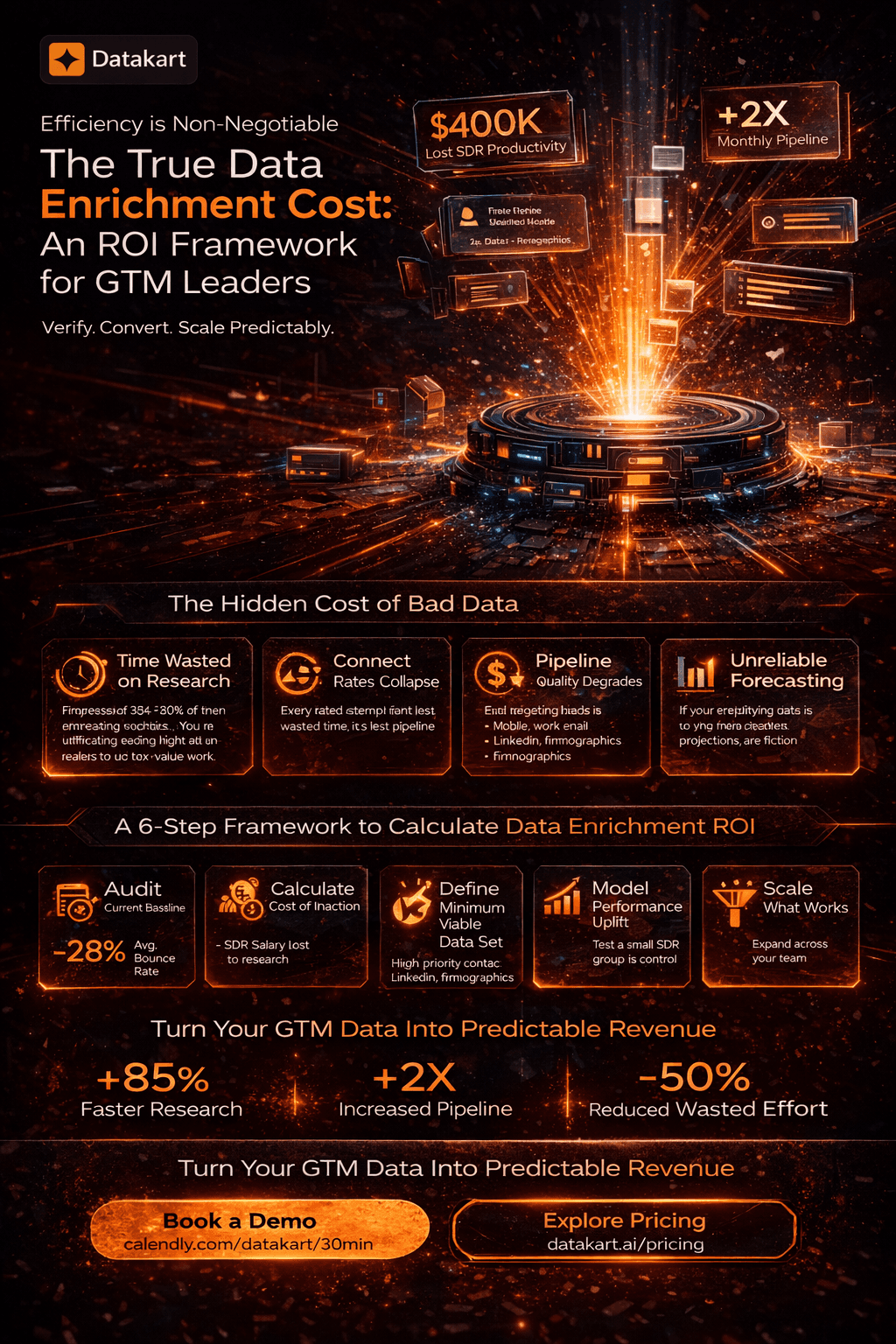
Stop guessing your data enrichment cost. Learn how to calculate ROI, uncover hidden costs, and scale outbound efficiency with a proven GTM framework.
Efficiency is no longer optional.
In today’s GTM environment, every dollar spent must translate into measurable pipeline impact.
Headcount is constrained, CAC is under scrutiny, and leadership expects predictable growth, not experimentation.
Yet one of the most misunderstood investments in this equation is data enrichment.
Most teams evaluate it incorrectly.
They focus on price per contact.
They should be measuring cost per outcome.
Because the real cost is not what you pay for data.
It is what you lose without it.
Bad data does not appear as a clear line item.
It shows up as inefficiency across your entire GTM motion.
SDR Time Gets Burned on Research
When reps spend 25 to 30 percent of their time verifying contacts, high-value sellers are performing low-value work.
At scale, this compounds quickly.
A 25-person SDR team losing six hours per week each results in 150 hours of lost productivity weekly.
That is equivalent to nearly four full-time employees.
Connect Rates Collapse
Incorrect phone numbers, outdated emails, and irrelevant contacts reduce effectiveness.
Every failed attempt represents lost pipeline opportunity.
Pipeline Quality Degrades
Poor data leads to weak targeting.
This results in poor-fit meetings, lower conversion rates, and longer sales cycles.
Forecasting Becomes Unreliable
If your underlying data is inaccurate, your pipeline projections cannot be trusted.
This leads to missed targets, inefficient budget allocation, and reduced confidence from leadership.
The problem is not just bad data.
It is static data.
Traditional enrichment follows a linear process.
Data is purchased, uploaded, and used until it decays.
Modern GTM teams operate differently.
They treat data as a real-time system.
Platforms like Datakart’s GTM intelligence platform enable continuous verification, real-time enrichment, and always-updated contact intelligence.
This fundamentally changes the economics.
Organizations are no longer buying data.
They are investing in continuous accuracy and operational efficiency.
Evaluating enrichment requires a structured approach focused on outcomes rather than inputs.
The process begins with auditing your current baseline.
Measure key indicators such as email bounce rates, connect rates, SDR research time, and data completeness.
This establishes a clear starting point.
Next, calculate the cost of inaction.
For example, if an SDR earning $80,000 annually spends 25 percent of their time on research, that equates to $20,000 in lost productivity per representative each year.
Across a team of 20 SDRs, this becomes $400,000 in wasted payroll alone.
Then define your minimum viable dataset.
Focus only on fields that directly impact revenue, such as verified mobile numbers, work emails, accurate job titles, LinkedIn profiles, and firmographic data.
Once defined, model potential performance improvements.
Typical gains may include doubling connect rates, reducing research time significantly, and increasing meetings per SDR by 50 to 100 percent.
Rather than scaling immediately, run a controlled pilot.
Test with a small team, defined territory, and clear success metrics.
Compare results against a control group to generate internal validation.
Finally, measure outcomes and scale.
Track improvements in connect rates, meetings booked, pipeline generated, and conversion rates.
Once performance gains are proven, expand across the organization.
A mid-market SaaS company with a 20-person SDR team struggled with inefficiency.
Each representative spent eight hours per week on research.
Connect rates remained at three percent, and each SDR booked an average of five meetings per month.
After implementing enriched and verified data through Datakart, performance improved significantly.
Research time was reduced by 85 percent.
Connect rates increased to seven percent.
Meetings per SDR doubled to ten per month.
Pipeline impact was substantial.
Monthly pipeline increased from $400,000 to $800,000 without additional hiring.
The organization did not increase effort.
It improved data quality.
Focusing only on price leads to poor decisions.
Low-cost data with low accuracy becomes expensive in practice.
The correct metric is cost per conversion, not cost per contact.
Treating enrichment as a one-time project limits effectiveness.
Data decays continuously, so enrichment must also be continuous.
Ignoring workflow integration reduces adoption.
Data must exist within CRM systems, sales engagement platforms, and marketing tools to be useful.
Failing to train teams reduces impact.
Sales teams must understand how to use data signals, personalize outreach, and trust the data they are given.
A modern GTM stack operates across three core layers.
The system of record, typically Salesforce or HubSpot, stores account and contact data.
The system of action, such as Outreach or Sales loft, executes engagement.
The system of intelligence powers both layers.
Platforms like Datakart’s data intelligence platform continuously verify, enrich, and update data to ensure accuracy across systems.
Organizations evaluating this capability often review Datakart’s pricing and enrichment plans to understand how enrichment integrates into their GTM strategy.
The result is a unified system where clean data drives execution and improves outcomes.
Data enrichment is not a cost center.
It is a growth lever.
When implemented correctly, it increases SDR productivity, improves conversion rates, reduces customer acquisition cost, and accelerates pipeline generation.
More importantly, it shifts your GTM engine from reactive to predictable.
The organizations that succeed are not those with the most data.
They are the ones with the most accurate and actionable data.
Ready to see the impact of better data?
Stop guessing what poor data is costing your business. Book a 30-minute demo with the Datakart team and explore how real-time data intelligence can transform your pipeline.
What is data enrichment cost?
Data enrichment cost refers to the investment required to enhance and verify contact and company data, but the true metric to evaluate is return on investment rather than price alone.
How do you calculate ROI for data enrichment?
ROI is calculated by comparing productivity gains, pipeline growth, and cost savings against the investment in data enrichment.
Is data enrichment worth it for large teams?
Yes, ROI increases with scale as efficiency improvements compound across larger teams.
What is the difference between data cleaning and data enrichment?
Data cleaning corrects existing inaccuracies, while enrichment adds new data points that improve targeting and outcomes.
Build a robust data validation infrastructure. Learn to implement real-time verification logic for email and phone checks to fuel your revenue engine.
March 28th, 2026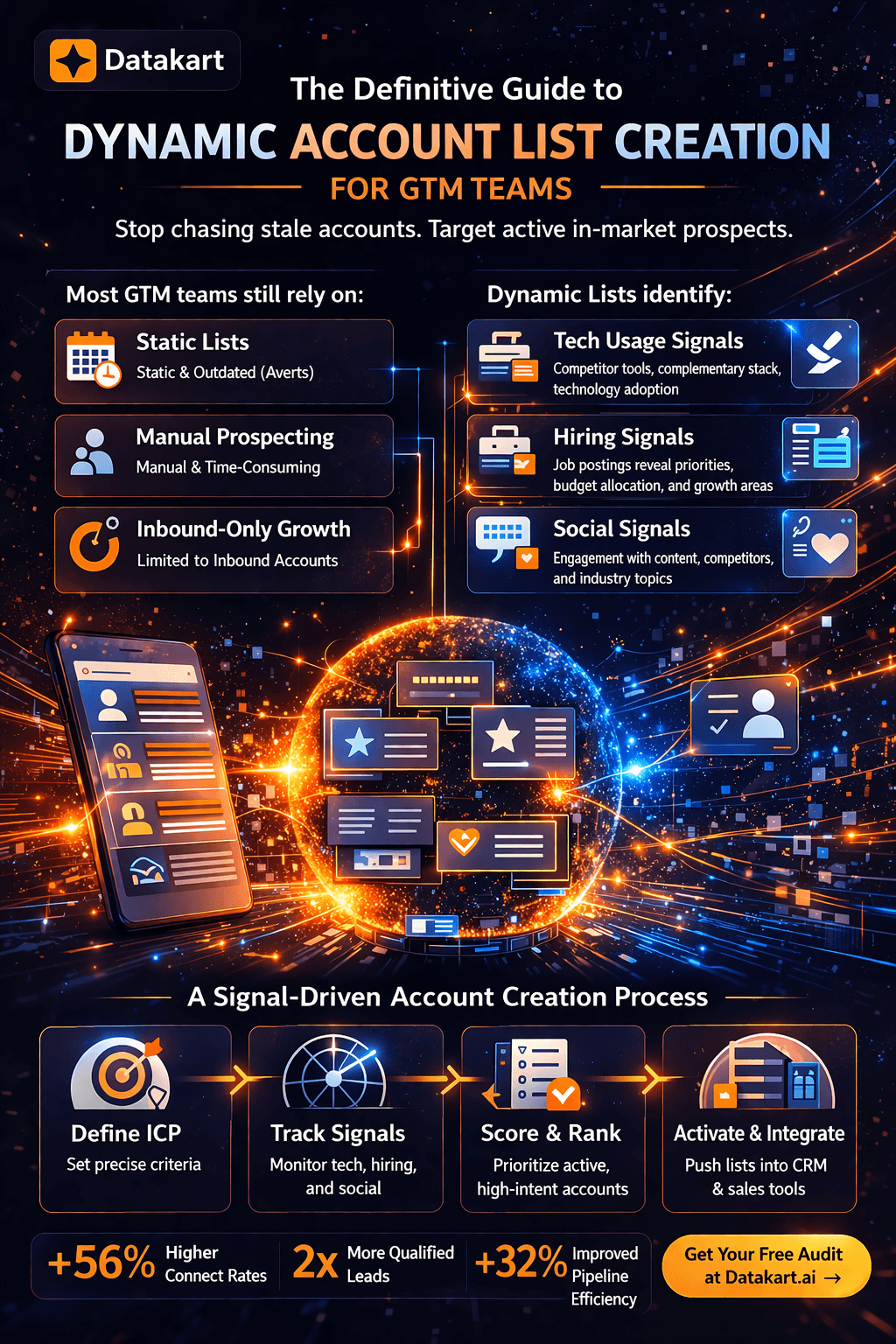
Stop wasting budget on stale data. Learn a step-by-step framework for account list creation using tech, hiring, and social signals for a high-precision GTM strategy.
March 28th, 2026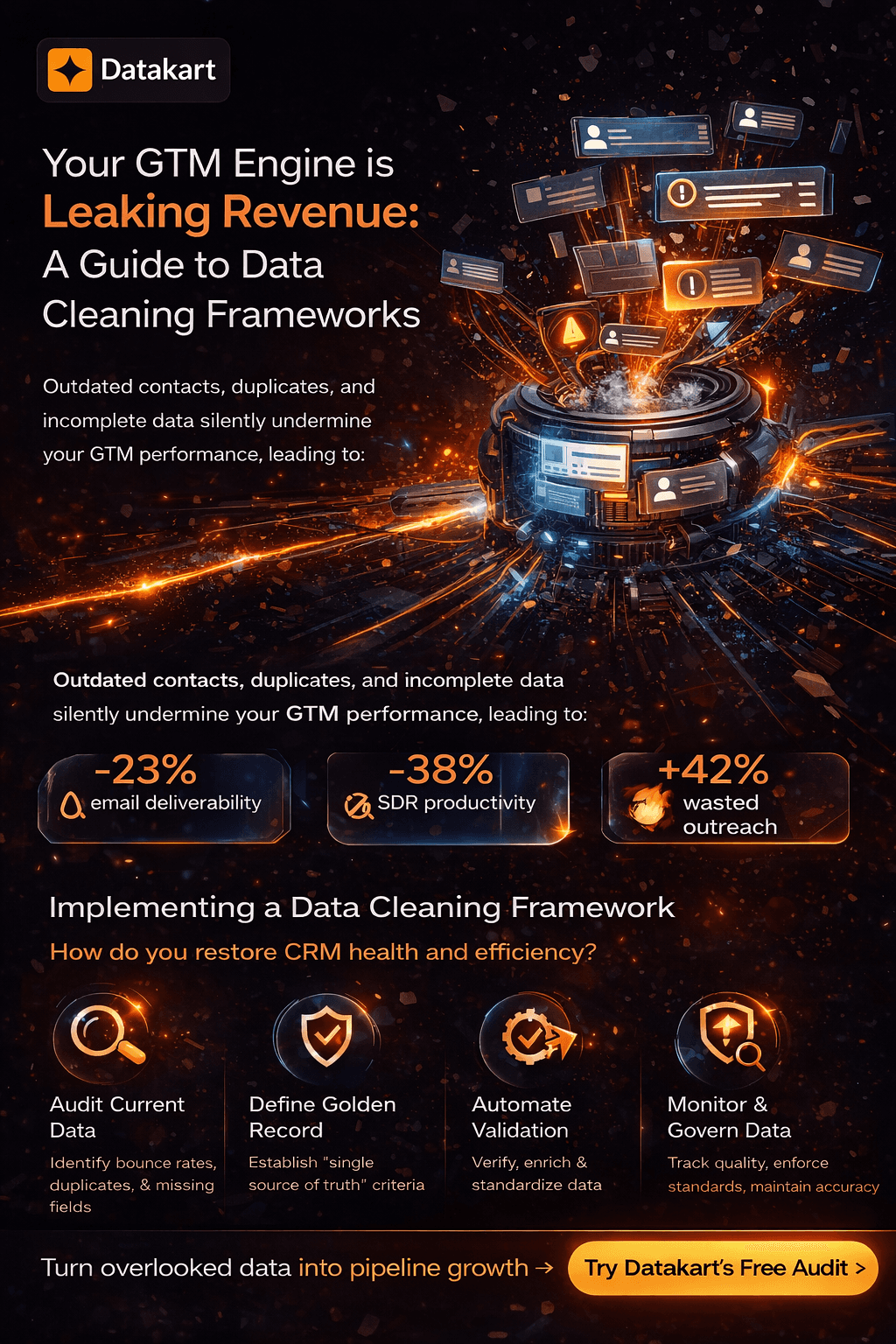
Stop losing revenue to bad data. Learn how scalable data cleaning frameworks help RevOps and GTM leaders build a reliable pipeline engine.
March 21st, 2026