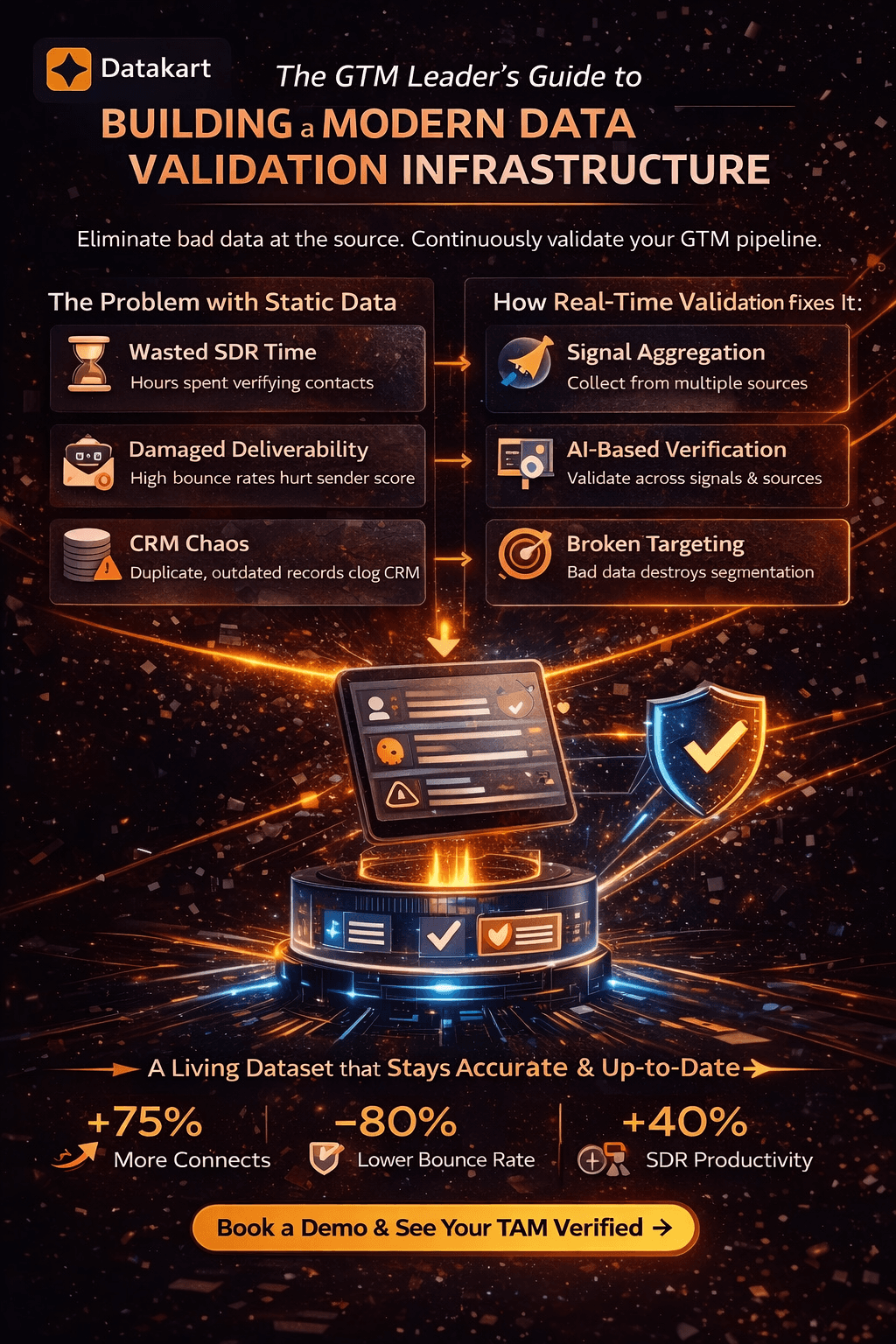
The GTM Leader's Guide to Building a Modern Data Validation Infrastructure
Build a robust data validation infrastructure. Learn to implement real-time verification logic for email and phone checks to fuel your revenue engine.
 March 28th, 2026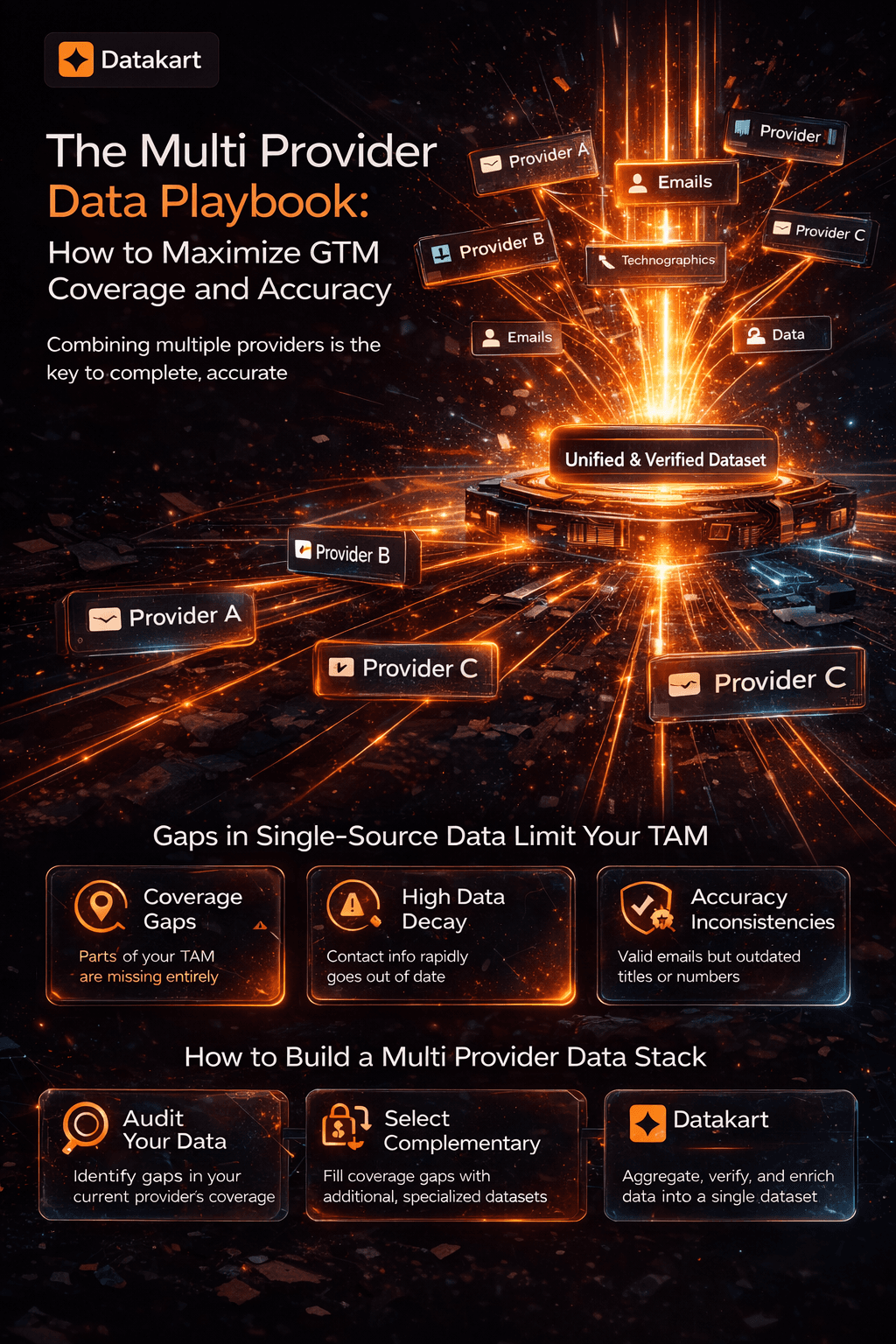
Stop relying on a single source. Learn how multi provider data improves coverage, boosts accuracy, and drives GTM performance.
Your GTM strategy lives and dies by the quality of your data. You can have a strong product, great messaging, and a capable sales team but if your data is incomplete or inaccurate, your execution breaks down.
Most teams still rely on a single data provider. It feels efficient, but it quietly limits your growth. Entire segments of your Total Addressable Market (TAM) remain unreachable, and your outreach suffers from gaps and inaccuracies.
The reality is simple: no single dataset can represent the full market.
High-performing GTM teams are shifting to a multi provider data model, one that prioritizes coverage, verification, and continuous enrichment.
Relying on one provider introduces structural limitations that compound over time.
Coverage Gaps Are Inevitable
Every provider has strengths and blind spots. Some are strong in enterprise tech, others in SMB or specific geographies. A single source means missing entire segments of your ICP.
Data Decay Happens Faster Than Refresh Cycles
Contacts change roles constantly. A dataset that was accurate a few months ago quickly becomes outdated. This leads to bounce rates, missed calls, and wasted effort.
Accuracy Is Inconsistent Across Fields
You might get a valid email but an outdated job title or generic phone number. This creates friction in outreach and reduces conversion rates.
Manual Workarounds Create Chaos
Teams often try to fix gaps by buying additional lists. This results in duplicates, conflicting data, and CRM clutter—making the problem worse.
The outcome is predictable: lower connect rates, inefficient SDR workflows, and lost pipeline opportunities.
The shift is not about adding more data it is about building a smarter system.
A multi provider data strategy uses dataset layering to combine multiple sources into one unified, verified dataset.
Instead of trusting one vendor, you aggregate, compare, and validate data across sources.
Platforms like Datakart.ai act as the intelligence layer that makes this possible.
Aggregation Across Sources
Data is pulled from multiple providers, each contributing its strengths; emails, phone numbers, firmographics, or technographics.
De-duplication and Unification
Records are merged intelligently, ensuring that multiple entries for the same contact become a single profile.
Verification and Prioritization
Each data point is validated and ranked. The system selects the most accurate and recent version of each field.
Continuous Updates
Instead of static lists, the dataset evolves in real time as new information becomes available.
The result is a “golden record” that is more accurate, more complete, and far more actionable than any single-source dataset.
A successful implementation requires structure, not guesswork.
Start by auditing your current data. Identify gaps in coverage, missing fields, and segments where your outreach underperforms.
Define your Ideal Customer Profile in detail, including the exact data points required for effective engagement emails, direct dials, job titles, and company attributes.
Select complementary providers based on your gaps. The goal is not redundancy, but coverage expansion.
Establish clear logic for your “golden record.” Decide which source takes priority for each field email, phone, title, or company data.
CTA: Want to see your TAM in action? Try Datakart’s Free Audit.
Implement a unification platform like Datakart.ai to automate aggregation, validation, and enrichment.
Integrate the unified dataset directly into your CRM and engagement tools so teams operate on a consistent, accurate data foundation.
Finally, monitor performance continuously. Track improvements in coverage, connect rates, and pipeline generation, and refine your strategy accordingly.
A mid-market SaaS company struggled with low connect rates despite strong targeting.
Their primary data provider offered reliable company data but weak phone coverage.
They introduced a multi provider approach:
• Retained their existing provider for firmographic data
• Added a second provider focused on direct-dial mobile numbers
• Used Datakart.ai to unify and verify both datasets
The results were immediate:
• 22% increase in connect rates
• 18% expansion in reachable TAM
• Reduced manual research time for SDRs
By layering datasets instead of replacing them, the company unlocked new pipeline without increasing headcount.
Adding multiple data sources without unification creates more problems than it solves.
Ignoring verification leads to conflicting and unreliable data.
Failing to define data ownership and governance results in long-term degradation.
Treating the system as static instead of continuously evolving limits its effectiveness.
A multi provider strategy only works when it is structured, automated, and continuously optimized.
Your CRM remains your system of record.
Your sales engagement tools execute outreach.
Your data platform becomes the intelligence layer that ensures accuracy and completeness.
Platforms like Datakart.ai sit at the center of this ecosystem, continuously validating and enriching data before it reaches your GTM teams.
Organizations evaluating scalability often review Datakart pricing to understand how a unified data layer fits into their GTM stack.
Relying on a single data provider limits your growth.
A multi provider data strategy gives you control over your TAM, improves data accuracy, and enables more effective outreach.
By combining multiple datasets, validating them with AI, and unifying them into a single source of truth, you transform your data from a bottleneck into a competitive advantage.
Ready to eliminate data gaps and maximize GTM coverage?
Book a 30-minute demo: https://calendly.com/datakart/30min
What is multi provider data?
It is the practice of combining multiple data sources into a single unified dataset to improve coverage and accuracy.
How does dataset layering improve coverage?
It fills gaps by combining strengths from different providers, ensuring more complete access to your target market.
Is multi provider data expensive?
While it involves multiple sources, the ROI from improved efficiency, higher connect rates, and better pipeline generation typically outweighs the cost.
How does Datakart.ai help with multi provider data?
Datakart acts as a unification and verification layer, combining data from multiple providers into a single, accurate, continuously updated dataset.
Build a robust data validation infrastructure. Learn to implement real-time verification logic for email and phone checks to fuel your revenue engine.
March 28th, 2026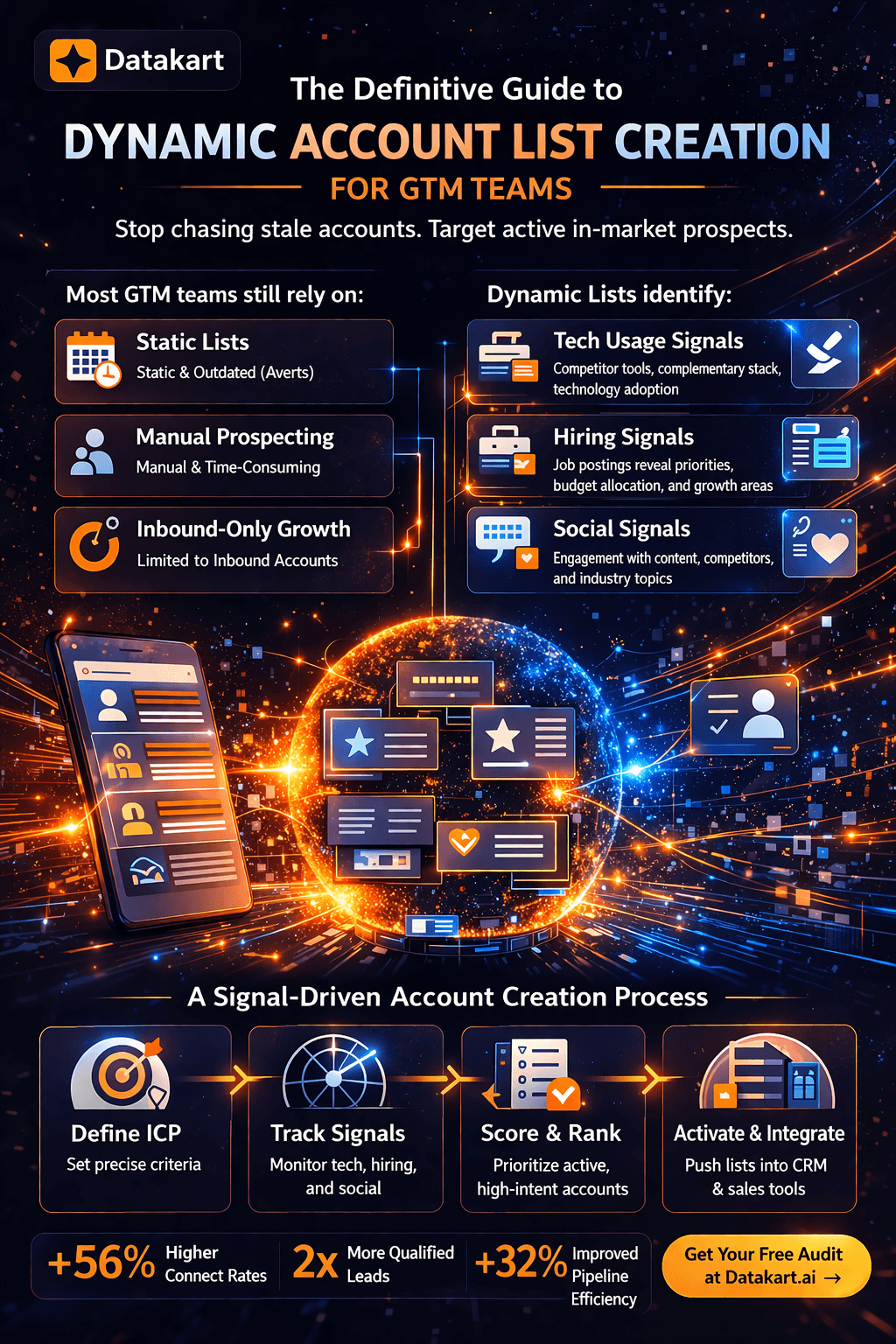
Stop wasting budget on stale data. Learn a step-by-step framework for account list creation using tech, hiring, and social signals for a high-precision GTM strategy.
March 28th, 2026
Stop losing revenue to bad data. Learn how scalable data cleaning frameworks help RevOps and GTM leaders build a reliable pipeline engine.
March 21st, 2026