
The GTM Leader's Guide to Building a Modern Data Validation Infrastructure
Build a robust data validation infrastructure. Learn to implement real-time verification logic for email and phone checks to fuel your revenue engine.
 March 28th, 2026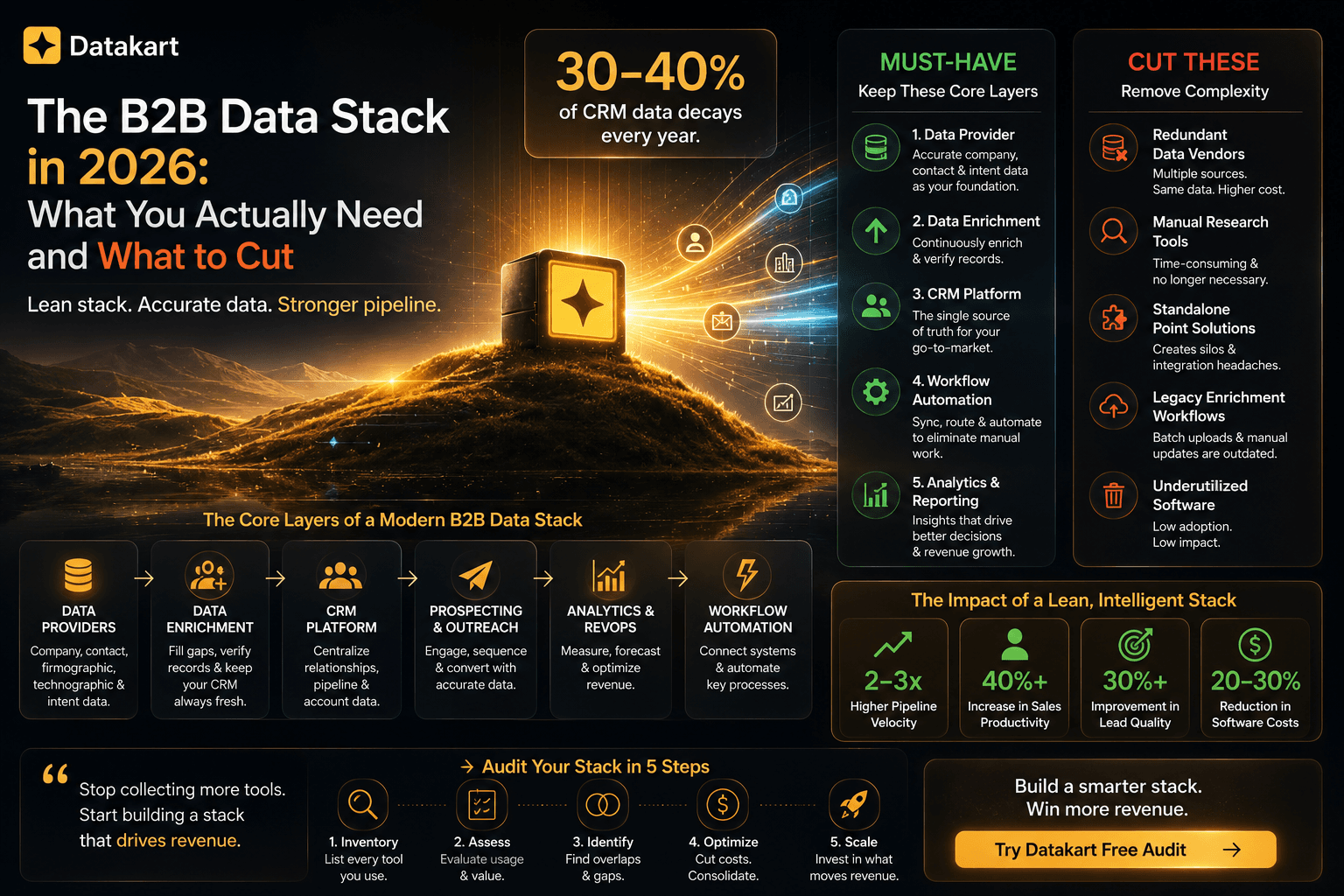
Sales and marketing teams in today’s times make use of multiple tools to make their operations efficient when it comes to database management. Yet there are several organizations that struggle with quality of data, unsuccessful, poor results when it comes to sales outreach or sending marketing campaigns to the right target audience.
Sales and marketing teams in today’s times make use of multiple tools to make their operations efficient when it comes to database management. Yet there are several organizations that struggle with quality of data, unsuccessful, poor results when it comes to sales outreach or sending marketing campaigns to the right target audience. This is because of poor data quality, duplicate records, disconnected workflows, and rising software costs. Business activities in 2026 are planned to enhance focus not on adding more applications but on developing a lean, efficient, well connected B2B data stack 2026 strategy.
There is an observed shift in priority towards data accuracy, automation, and workflow efficiency. This is because companies no longer believe in using complex tools but look for ones that provide real value. Let us see what must have technologies in the slack and what can be skipped to enhance productivity, minimize costs, and get better results across sales and marketing.
The right modern data stack plays an important role in prospecting, lead management, account research, enrichment, personalization, and revenue operations. Every customer interaction must be meaningful providing optimal benefits with no compromise on quality and accessibility of the information available to every team member.
Firms that still make use of disconnected B2B data tools can face following issues like:
Choosing a well-designed stack makes sure the flow of data is seamless across systems which allows sales, marketing, and customer success teams an access to accurate information when most needed.
With organizations shifting from large collections of niche tools towards integrated platforms, there is better organizational support offered across multiple use cases.
A successful, effective B2B data stack 2026 framework must include different key layers.
Data providers share information of the company, contact details, firmographics, technographic, and buying signals, forming the essential foundation of prospecting and account intelligence.
Records are continually updated by enrichment platforms thereby filling in missing information. With use of modern data enrichment tools, CRM accuracy can be maintained over a period of time while saving the efforts put in manual research.
CRM is a significant repository to gather essential information on customers and prospects, acting as an operational hub that connects to other systems.
Sales engagement platforms help with email outreach, sequencing, follow-ups, and activity tracking to ensure successful outreach given reliable data.
Reporting tools give insights on pipeline performance, campaign effectiveness, and revenue generation. The accuracy of reporting depends on the quality of upstream data.
Automation tools enable synchronization of data between platforms to minimize and eliminate repetitive manual tasks. This automation is more a need than luxury in today’s times.
Not every category of industry requires multiple vendors. Most organizations can operate efficiently with a carefully selected set of essential technologies.
It is essential to use one of the best B2B data platforms that provide comprehensive company intelligence, contact information, enrichment capabilities, and ongoing updates.
This allows business owners and teams to channelize their focus and efforts in more productive roles than maintaining multiple overlapping databases. Platforms like DataKart enable GTM teams to centralize data workflows, minimize tool sprawl, and enhance data reliability across sales and marketing functions.
Data quality deteriorates quickly as numbers become invalid, change of numbers as jobs are changed and companies grow. With strong data enrichment tools in place, CRM records are continually updated and kept active.
The use of automated enrichment workflows minimizes manual effort that otherwise would be put in database management.
A CRM is one of the most critical components of any sales tech stack that provides some visibility into customer interactions, pipeline movement, and account history. It forms the base of all advanced data management tools that otherwise lose effectiveness.
Teams must automate repetitive processes like lead routing, enrichment triggers, duplicate management, and system synchronization to enhance consistency, while enabling teams to channelize their efforts on higher-value activities.
Organizations must have clear visibility into data quality, pipeline health, conversion rates, and revenue performance which can be achieved with use of modern analytics tools that enable leadership to make informed decisions based on reliable information.
Building an efficient stack often involves removing unnecessary software.
Many companies subscribe to several providers that deliver nearly identical information. Conducting a regular B2B data provider’s comparison often reveals significant overlap.
Consolidating vendors can reduce costs while simplifying workflows.
If employees spend hours searching for company details or contact information, there may be a gap in your primary data platform. Modern solutions increasingly automate these activities.
Single-purpose tools that solve only one narrow problem often create integration challenges. If a core platform already includes similar functionality, maintaining separate subscriptions may not be worthwhile.
Manual spreadsheet uploads and batch updates were common in the past. In 2026, real-time enrichment and automated syncing are becoming the standard.
If a tool is rarely used or delivers minimal business impact, it may be time to retire it. Regular usage reviews help identify opportunities for cost optimization.
It is essential to conduct periodic audits to catch any inefficiencies and unnecessary spending at an early stage. One can begin by first creating an inventory list of every platform used across the organization by sales, marketing, and operations teams.
Once done, assess:
Businesses must review the renewal costs along with adoption metrics to find what applications can be eliminated without affecting performance.
The goal is not to build the largest sales tech stack but the most efficient one.
Organizations are focusing on refining and enriching their B2B data stack 2026 with successful strategies to ensure more effective tools are used than just using huge numbers of tools that just add to the cost. Efficient stacks are those that work efficiently and provide a balance of data accuracy, seamless integrations, automation, and clear visibility into revenue operations.
Conducting periodic audits of different technology invested in and channelizing efforts in essential capabilities, businesses create a leaner, more productive foundation for growth. Reputed brands like DataKart significantly contribute here by enabling teams to consolidate data workflows and maintain a well-connected, reliable go-to-market ecosystem.
A B2B data stack is the collection of platforms and technologies used to gather, enrich, manage, analyze, and activate business data for sales, marketing, and revenue operations.
Data quality declines continuously as contacts change roles and companies evolve. Modern data enrichment tools help keep records accurate, improving targeting, personalization, and reporting.
Most organizations benefit from having one primary provider and adding specialized solutions only when a clear business need exists. A regular B2B data provider’s comparison can help identify overlap.
The best B2B data platforms are those that combine data quality, enrichment capabilities, workflow integrations, and scalability while supporting the specific needs of go-to-market teams.
A comprehensive review every six to twelve months helps ensure your B2B data stack 2026 strategy remains efficient, cost-effective, and aligned with business goals
Build a robust data validation infrastructure. Learn to implement real-time verification logic for email and phone checks to fuel your revenue engine.
March 28th, 2026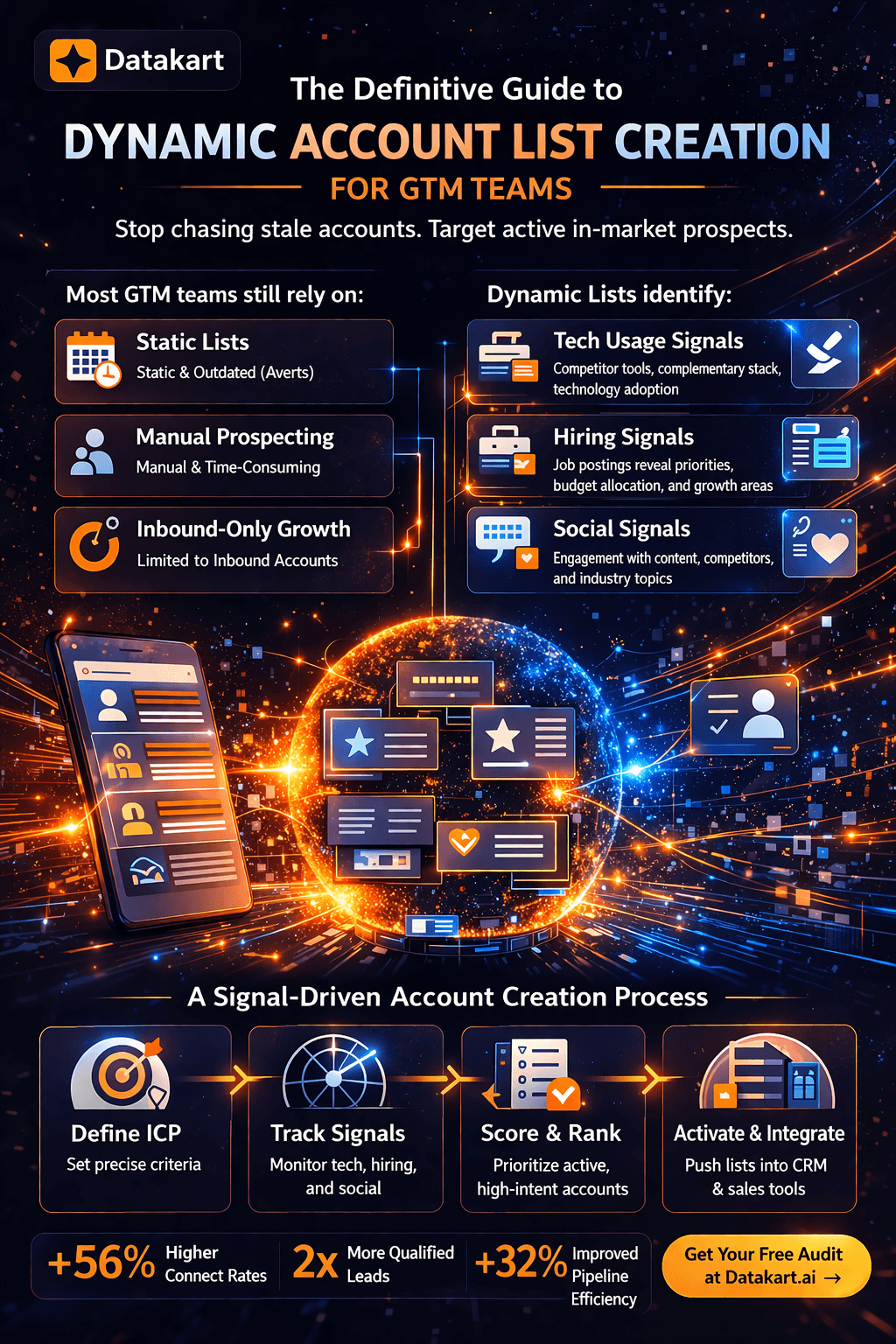
Stop wasting budget on stale data. Learn a step-by-step framework for account list creation using tech, hiring, and social signals for a high-precision GTM strategy.
March 28th, 2026
Stop losing revenue to bad data. Learn how scalable data cleaning frameworks help RevOps and GTM leaders build a reliable pipeline engine.
March 21st, 2026