
The GTM Leader's Guide to Building a Modern Data Validation Infrastructure
Build a robust data validation infrastructure. Learn to implement real-time verification logic for email and phone checks to fuel your revenue engine.
 March 28th, 2026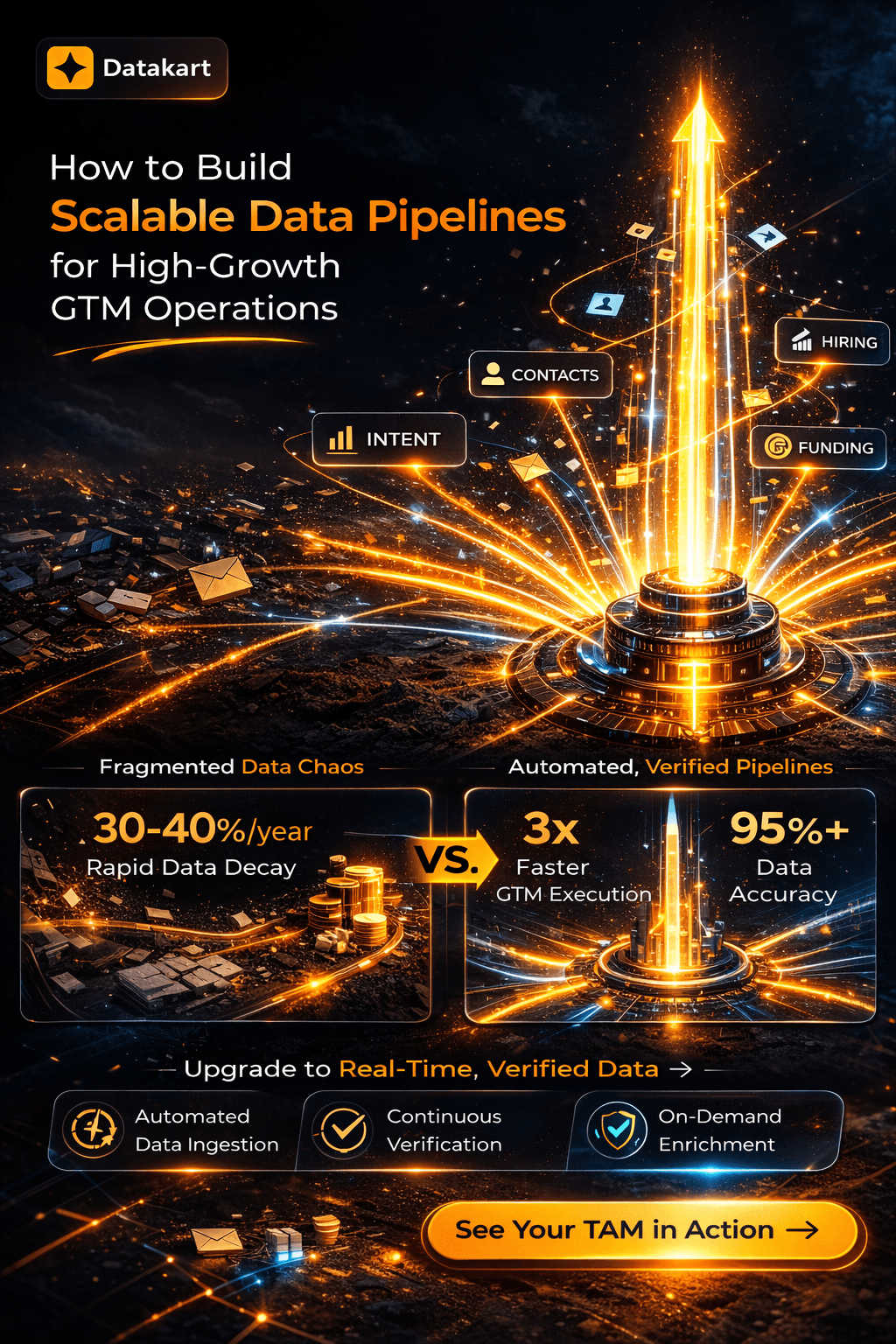
Stop relying on stale data. Learn to build scalable data pipelines for your GTM operations and drive revenue with automated enrichment and verification.
Go-to-market strategy today is fundamentally driven by data. Every decision—from targeting to messaging to pipeline forecasting—depends on how accurate and timely your data is. Yet most GTM and RevOps teams still operate with fragmented systems, outdated records, and manual workflows.
The result is predictable: wasted sales cycles, low conversion rates, and inconsistent pipeline growth.
The traditional model of periodic list purchases and manual CRM updates is no longer viable. High-performing teams are shifting toward scalable data pipelines—systems that continuously ingest, validate, and enrich data in real time.
These pipelines are no longer optional. They are the foundation of predictable, scalable GTM execution.
For years, GTM teams have relied on reactive data practices. A campaign begins, a list is purchased, and outreach begins. When data quality issues arise, another list is purchased.
This creates a compounding cycle of inefficiency.
Rapid Data Decay
B2B data changes constantly. Contacts switch roles, companies evolve, and technologies change. According to Gartner’s data quality research, poor data quality costs organizations millions annually.
Static data quickly becomes obsolete, making outreach ineffective.
Wasted Sales Resources
Sales development representatives often spend significant time verifying contacts instead of engaging prospects. This reduces productivity and delays pipeline generation.
Inaccurate Targeting
Without continuously updated data, ICP definitions become outdated. Accounts that were once ideal may no longer be relevant due to changes in technology, hiring patterns, or business priorities.
Data Silos Across Systems
Marketing, sales, and customer success often operate on disconnected datasets. Without a unified data layer, it becomes difficult to create a consistent customer journey or accurate revenue forecasts.
These challenges are not isolated, they are systemic issues that prevent GTM strategies from scaling effectively.
Modern GTM teams are moving from static data ownership to dynamic data access.
Instead of purchasing lists, they build pipelines powered by real-time intelligence platforms like Datakart’s GTM data platform.
This shift introduces three critical capabilities.
Automated Data Ingestion
Data is continuously collected from multiple sources including firmographic data, technographic signals, and intent indicators.
Continuous Verification
Data is constantly validated to ensure accuracy. Email addresses, job roles, and company attributes are checked and updated automatically.
On-Demand Enrichment
Missing or outdated data is enriched in real time or through scheduled processes, ensuring that CRM records remain complete and actionable.
This transforms data from a static asset into a continuously improving system that powers every GTM workflow.
Creating a scalable data pipeline requires a structured, system-first approach.
The process begins with a complete audit of your existing data ecosystem. Every system that stores customer or prospect data, CRM, marketing automation, and sales tools, must be mapped. Understanding where data originates and how it flows reveals inefficiencies and gaps.
Next, high-performing teams redefine their Ideal Customer Profile using dynamic attributes. Instead of relying solely on firmographics, they incorporate signals such as technology usage, hiring trends, and intent behavior.
A centralized data hub then becomes essential. CRM platforms like Salesforce or HubSpot serve as the single source of truth, ensuring all teams operate from consistent data.
Automation is the next critical layer. Data ingestion should occur automatically through APIs and integrations rather than manual uploads. Every new contact or account should enter the system already validated and enriched.
CTA: Want to see your TAM in action? Try Datakart’s Free Audit.
Continuous enrichment ensures that data remains accurate over time. Regular validation processes update records, fill missing fields, and flag outdated information.
Finally, clean data must be activated across GTM tools. Sales engagement platforms receive verified contact details, while marketing systems leverage enriched data for segmentation and personalization.
Consider a mid-market SaaS company struggling with inefficient outbound processes.
Their SDR team spent hours each week manually researching contacts, while marketing campaigns suffered from high bounce rates. The CRM contained outdated and incomplete records.
After implementing a scalable data pipeline, the company transformed its GTM execution.
They began by enriching their existing database, cleaning outdated records and filling missing fields. Automated workflows ensured all new leads were enriched in real time.
Verified data was then integrated directly into sales engagement tools, enabling more effective outreach.
The results were significant.
• Email bounce rates dropped dramatically
• SDR productivity increased as manual research decreased
• Connect rates improved due to accurate contact data
• Marketing-driven pipeline increased substantially within two quarters
The improvement was driven not by increased activity, but by improved data quality.
While building data pipelines, several common pitfalls can limit effectiveness.
Automating poor-quality data is a frequent mistake. Without cleaning existing records, automation simply amplifies inaccuracies.
Another issue is prioritizing data volume over accuracy. Large datasets with poor quality are far less effective than smaller, verified datasets.
Lack of alignment across teams also creates friction. Sales, marketing, and operations must share a unified definition of ICP and data standards.
Finally, rigid systems can limit scalability. Data pipelines should evolve alongside GTM strategies and market changes.
A modern GTM stack relies on three core layers.
The CRM acts as the system of record, storing account and pipeline data.
Sales engagement platforms drive outreach execution.
The intelligence layer sits above these systems.
Platforms like Datakart’s real-time data intelligence platform continuously enrich and validate data before it reaches downstream tools.
Organizations evaluating this layer often explore Datakart’s pricing and enrichment plans to understand how scalable data pipelines fit within their GTM strategy.
Scalable data pipelines are no longer a technical upgrade—they are a strategic requirement.
They enable GTM teams to move from reactive data management to proactive data intelligence. Instead of constantly fixing data issues, teams operate with continuously verified and enriched information.
This shift leads to higher efficiency, stronger pipeline generation, and more predictable revenue growth.
In modern GTM environments, data quality is directly tied to performance.
Ready to build a GTM engine powered by accurate, real-time data?
Stop relying on outdated lists and manual processes. Book a 30-minute demo with the Datakart team and see how scalable data pipelines can transform your revenue operations.
What are data pipelines in GTM?
Data pipelines are automated systems that collect, validate, enrich, and distribute prospect and customer data across GTM tools, ensuring teams always work with accurate information.
How do automation flows improve data quality?
Automation eliminates manual errors by continuously validating and updating data, ensuring CRM records remain accurate and complete.
What is batch enrichment?
Batch enrichment is the process of updating large datasets with additional or corrected information, improving segmentation and targeting accuracy.
How long does it take to implement a data pipeline?
With modern platforms, basic implementation can be completed quickly, while full optimization typically occurs over a few months depending on system complexity.
Build a robust data validation infrastructure. Learn to implement real-time verification logic for email and phone checks to fuel your revenue engine.
March 28th, 2026
Stop wasting budget on stale data. Learn a step-by-step framework for account list creation using tech, hiring, and social signals for a high-precision GTM strategy.
March 28th, 2026
Stop losing revenue to bad data. Learn how scalable data cleaning frameworks help RevOps and GTM leaders build a reliable pipeline engine.
March 21st, 2026