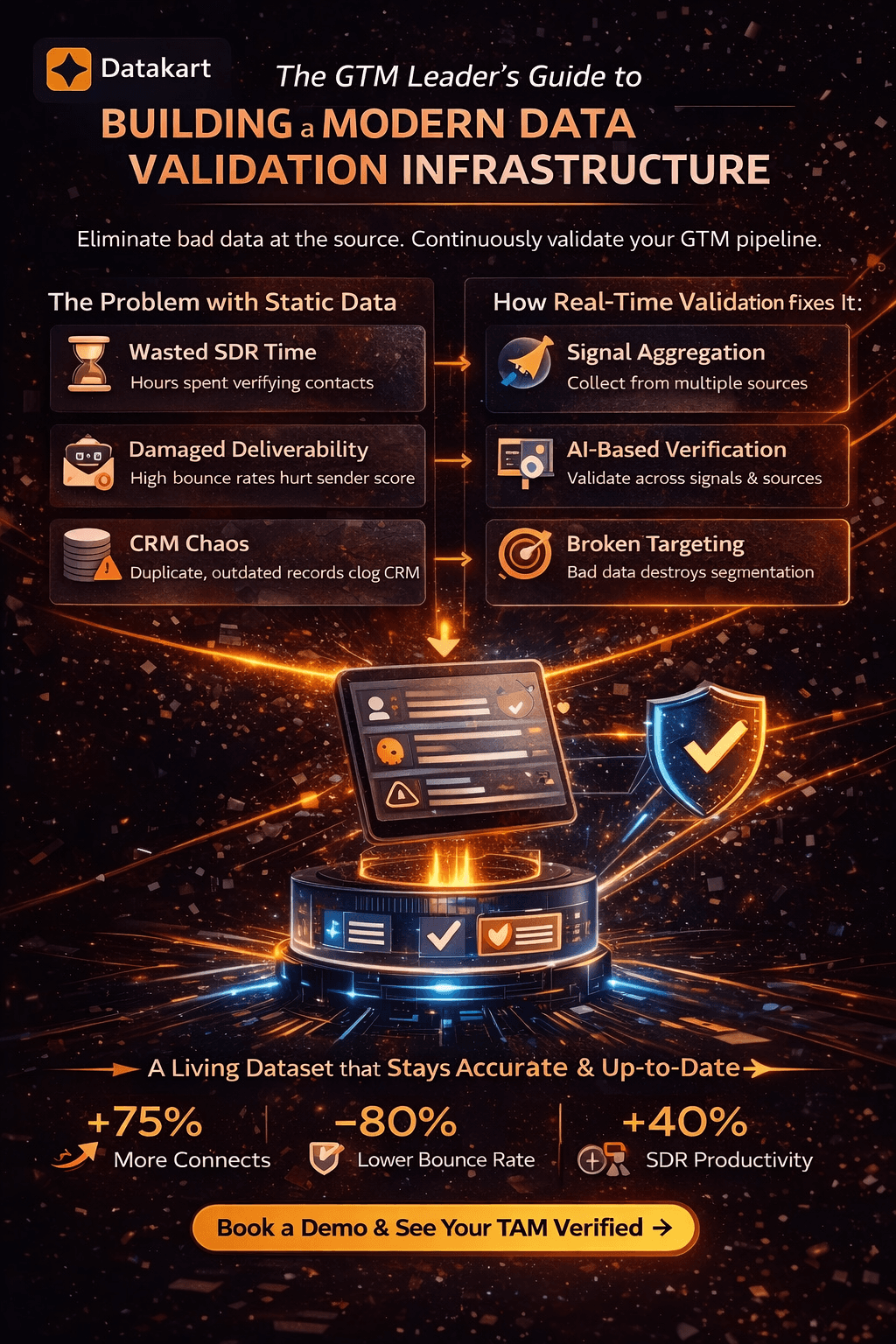
The GTM Leader's Guide to Building a Modern Data Validation Infrastructure
Build a robust data validation infrastructure. Learn to implement real-time verification logic for email and phone checks to fuel your revenue engine.
 March 28th, 2026
Stop wasting budget on inaccurate job titles. Learn how role mapping and seniority targeting improve pipeline, connect rates, and GTM efficiency.
Your GTM team isn’t struggling because of effort, it’s struggling because of targeting.
SDRs are spending hours reaching out to contacts who don’t influence buying decisions. Marketing campaigns are hitting the wrong level of seniority. Pipeline looks active, but conversion rates tell a different story.
The root cause is simple: you are targeting job titles, not decision-makers.
Titles are inconsistent, inflated, and often misleading. In modern B2B organizations, influence is distributed across functions and buying committees not captured in a single title field.
This is where role mapping changes the game.
Instead of guessing based on titles, you identify who actually owns the problem, who influences the decision, and who signs the deal.
Traditional GTM strategies rely heavily on job titles. This approach no longer works at scale.
Titles Are Inconsistent
A “Director” in one company could be equivalent to a “Manager” in another. A “Head of Growth” might function as a VP, or an individual contributor.
Organizations Are Dynamic
Roles evolve constantly. Promotions, restructuring, and hiring shifts make static title lists outdated quickly.
Buying Committees Are Complex
Modern B2B deals involve multiple stakeholders. According to Gartner, buying groups often include 6-10 decision-makers. A single title cannot represent that complexity.
Function ≠ Title
The same function can appear under dozens of titles. Demand generation could sit under marketing, revenue, or growth teams.
When you rely only on titles, you systematically miss large portions of your TAM.
Role mapping shifts your strategy from labels to logic.
Instead of asking “What is their title?”, you ask:
• What function do they own?• What level of influence do they have?• Where do they sit in the buying process?
Platforms like Datakart.ai enable this by combining data verification with AI-driven classification.
Function Mapping
Contacts are categorized based on actual responsibilities, not titles. This ensures you target the right business function regardless of naming variations.
Seniority Identification
Beyond keywords like “VP” or “Manager,” seniority is determined using signals like reporting structure, role scope, and experience.
Continuous Data Verification
As contacts change roles, your data updates automatically. Your team always works with current, accurate information.
The result is a much clearer picture of your true buyers.
To implement role mapping effectively, you need a structured approach.
Start by redefining your Ideal Customer Profile. Focus on responsibilities, not titles. Identify who owns the problem your product solves.
Map the key business functions relevant to your solution. For example, a data platform may target data engineering, analytics, and RevOps functions.
Define seniority tiers clearly. Separate economic buyers, influencers, and users. This helps align outreach and messaging.
Layer in intent signals and technographic data to prioritize in-market accounts.
CTA: Want to see your TAM in action? Try Datakart’s Free Audit.
Use a platform like Datakart.ai to automate role classification, enrichment, and verification.
Integrate this data into your CRM and sales tools so teams can act on it immediately.
Finally, measure performance. Track connect rates, meeting quality, and pipeline conversion—not just activity.
A SaaS company targeting finance teams faced low connect rates and long sales cycles.
Their SDRs were reaching anyone with “finance” in their title, from analysts to CFOs.
After implementing role mapping:
• They focused on Accounts Payable and Corporate Finance functions• Prioritized Director and VP-level contacts• Added context through technographic signals
The results:
• Connect rates more than doubled• Meetings were consistently with decision-makers• Sales cycles shortened significantly
By targeting roles instead of titles, they improved both efficiency and outcomes.
Treating role mapping as a one-time setup leads to outdated targeting. Data must be continuously refreshed.
Focusing on a single persona ignores the buying committee. Multiple roles must be mapped and engaged.
Misalignment between sales and marketing creates inconsistent execution. Both teams must operate on the same role definitions.
Ignoring data quality undermines the entire strategy. Without verified data, role mapping breaks down.
A strong GTM stack combines execution tools with a reliable data foundation.
Your CRM remains your system of record.
Your engagement tools handle outreach and sequencing.
Your data platform ensures accuracy, enrichment, and role classification.
Platforms like Datakart.ai provide this intelligence layer, enabling precise targeting at scale.
If you're evaluating implementation, reviewing Datakart pricing helps understand how role mapping fits into your GTM investment.
Titles are no longer a reliable proxy for decision-making power.
Role mapping provides the clarity needed to engage the right people, at the right level, with the right message.
By combining function mapping, seniority identification, and verified data, GTM teams can move from broad targeting to precise execution.
This shift improves connect rates, accelerates pipeline, and creates a more predictable revenue engine.
Ready to stop targeting titles and start targeting decision-makers?
Book a 30-minute demo: https://calendly.com/datakart/30min
What is role mapping in GTM?
Role mapping is the process of identifying contacts based on their function and seniority rather than relying solely on job titles.
Why is title-based targeting ineffective?
Titles vary widely across organizations and often fail to reflect actual responsibilities or decision-making power.
How does role mapping improve pipeline?
It ensures outreach reaches the right stakeholders, improving connect rates and conversion efficiency.
Can role mapping integrate with existing tools?
Yes, platforms like Datakart integrate with CRMs and sales tools to enable role-based targeting within existing workflows.
Build a robust data validation infrastructure. Learn to implement real-time verification logic for email and phone checks to fuel your revenue engine.
March 28th, 2026
Stop wasting budget on stale data. Learn a step-by-step framework for account list creation using tech, hiring, and social signals for a high-precision GTM strategy.
March 28th, 2026
Stop losing revenue to bad data. Learn how scalable data cleaning frameworks help RevOps and GTM leaders build a reliable pipeline engine.
March 21st, 2026