
The GTM Leader's Guide to Building a Modern Data Validation Infrastructure
Build a robust data validation infrastructure. Learn to implement real-time verification logic for email and phone checks to fuel your revenue engine.
 March 28th, 2026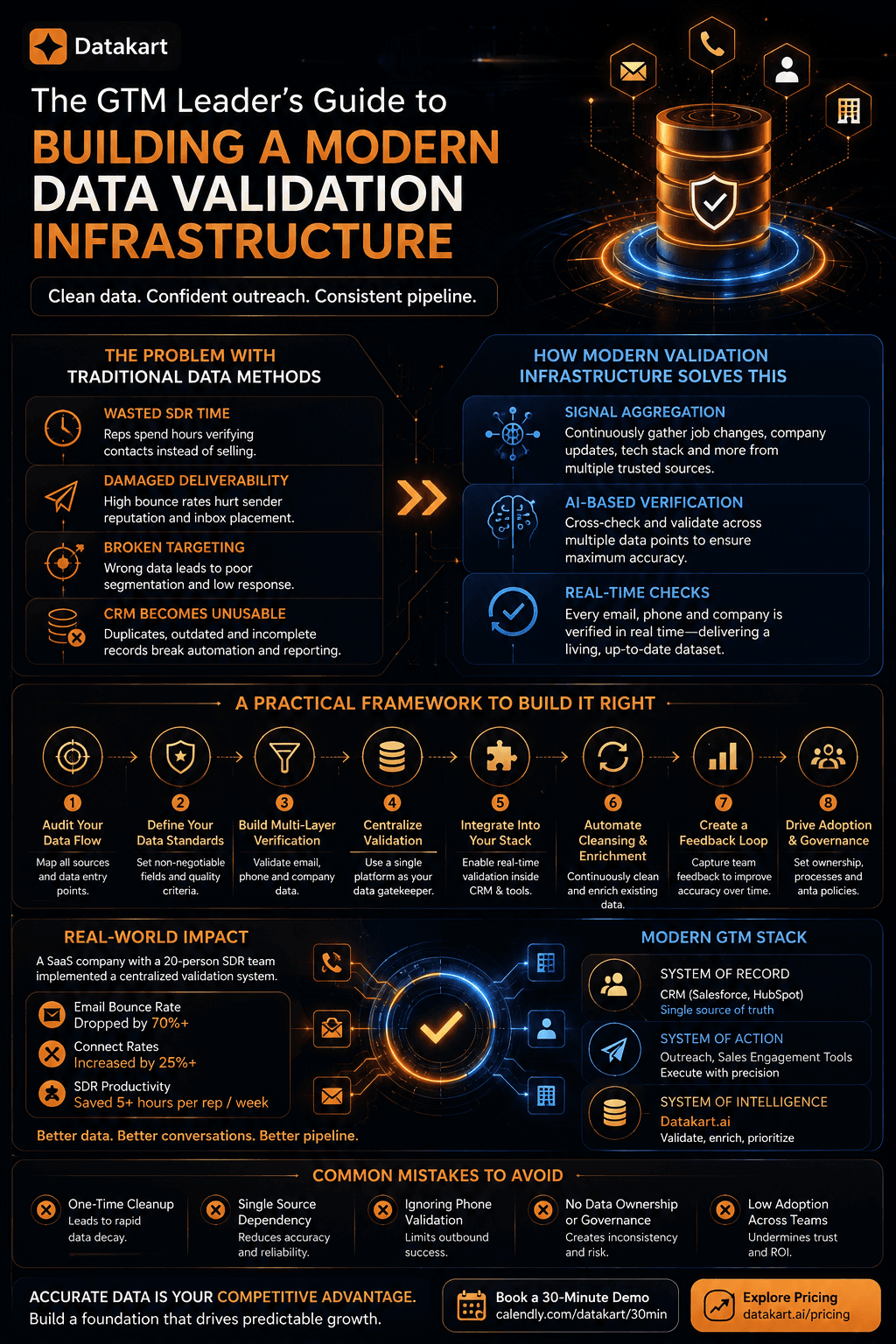
The modern GTM motion is no longer powered by static lists and disconnected tools.
In 2026, the highest-performing revenue teams are building intelligent, adaptive systems that continuously validate accounts, contacts, intent, hiring signals, and buying readiness in real time. The traditional “database + CRM” approach is breaking down under the pressure of shorter sales cycles, higher CAC, and increasingly fragmented buyer journeys.
For Demand Gen leaders, RevOps teams, and founders, the question is no longer whether data matters. The real question is whether your B2B data stack can keep up with market movement.
A stale contact database today can derail outbound performance, lower enrichment accuracy, waste ad spend, and distort pipeline forecasting. Meanwhile, companies using AI-driven enrichment and verification layers are improving targeting precision while reducing operational overhead.
According to Gartner, poor data quality costs organizations millions annually through inefficiency and lost opportunities. Modern GTM execution depends on verified, dynamic, and context-aware data systems.
This shift is redefining the architecture of the modern B2B data stack.
Most B2B teams still operate on workflows designed for a slower market.
The legacy process usually looks like this:
The problem is that B2B data decays extremely fast.
People change jobs. Companies raise funding. Teams restructure. Buying committees evolve. Technology adoption changes quarterly. By the time a static list reaches SDRs, a significant portion of the information is already outdated.
This creates several downstream problems:
Cold outreach performance drops when email addresses, titles, or company structures are outdated. SDRs spend more time cleaning records than selling.
Many companies rely on disconnected enrichment vendors, intent platforms, spreadsheets, and CRMs that do not communicate effectively. The result is duplicate records, inconsistent segmentation, and poor attribution.
Static ICP definitions fail to capture real-time market shifts. Companies continue targeting accounts that no longer fit their buying criteria while missing emerging opportunities.
Modern buyers expect relevance. Generic outreach based on outdated firmographics no longer works. GTM teams need contextual signals such as hiring trends, technology adoption, expansion activity, and intent behavior.
This is why the old B2B data stack is rapidly becoming obsolete.
The next generation of GTM infrastructure is centered around continuous verification and AI-driven enrichment.
Instead of treating data as a one-time purchase, modern systems treat data as a living operational layer.
This is where AI-powered platforms like Datakart.ai are changing the workflow.
Rather than simply providing contact records, AI-verified systems continuously evaluate:
The difference is methodological.
Traditional vendors focus on data volume.
Modern systems focus on data accuracy, signal layering, and real-time prioritization.
This shift enables GTM teams to:
AI also helps prioritize accounts based on likelihood to convert instead of relying solely on static ICP filters.
The result is a significantly smarter RevOps tech stack.
For example, instead of targeting “all SaaS companies with 200–500 employees,” modern GTM teams can target:
SaaS companies hiring RevOps leaders, adopting new sales engagement tools, expanding into North America, and showing active buying intent.
That level of precision fundamentally changes pipeline efficiency.
For more context on data-driven GTM infrastructure, HubSpot’s RevOps framework provides a useful external reference:https://blog.hubspot.com/service/revops
Here is a practical framework GTM teams can use to modernize their B2B data stack in 2026.
Move beyond static firmographics.
Include operational signals such as:
This creates a far more actionable TAM.
Disconnected tools create fragmentation.
Consolidate enrichment, CRM sync, account intelligence, and intent signals into a unified workflow where possible.
A strong RevOps tech stack should reduce manual exports and spreadsheet dependencies.
More contacts do not automatically create more pipeline.
Focus on:
Smaller, cleaner datasets outperform massive stale databases.
Explore pricing and workflow options here:https://www.datakart.ai/pricing
Your TAM should evolve automatically based on live conditions.
For example:
Dynamic segmentation improves campaign relevance dramatically.
Data should not live in isolation.
The best B2B data tools in 2026 integrate directly with:
Operational speed becomes a competitive advantage.
Most teams measure pipeline performance but ignore data quality KPIs.
Track:
These metrics directly impact revenue efficiency.
Consider a hypothetical SaaS company targeting mid-market fintech organizations.
Before modernizing its stack, the company relied on quarterly list purchases and manual enrichment workflows. SDR connect rates were low, CRM duplication issues were frequent, and outbound campaigns underperformed.
The company rebuilt its B2B data stack using:
The results after six months:
The key improvement was not simply “better data.”
It was the ability to continuously update account prioritization using live operational signals.
That is the future of the modern sales intelligence platform comparison landscape: systems that optimize continuously instead of periodically.
Here are the most common reasons GTM data initiatives fail:
These mistakes create inefficiency across the entire revenue engine.
The best-performing RevOps teams are building layered ecosystems instead of relying on a single vendor.
A modern B2B data stack typically includes:
Layer
Purpose
CRM
Central source of account activity
Enrichment Platform
Contact and company verification
Intent Data
Buying behavior analysis
Sales Engagement
Outbound execution
Analytics Layer
Attribution and forecasting
AI Verification Engine
Real-time signal validation
Platforms like Datakart.ai fit into this ecosystem by providing dynamic account intelligence and verified data layers that integrate alongside CRMs and outbound workflows.
The goal is not replacing your CRM.
The goal is improving the quality and actionability of the data flowing through it.
Learn more about modern GTM workflows here:https://www.datakart.ai/
The B2B data stack in 2026 is no longer just infrastructure.
It is a competitive advantage.
Teams that continue relying on static databases and manual workflows will struggle with lower efficiency, weaker personalization, and rising acquisition costs.
Meanwhile, companies adopting AI-verified, continuously updated data systems are building faster, smarter, and more scalable GTM motions.
The future belongs to dynamic data operations.
Want to modernize your GTM infrastructure and improve pipeline precision? Book a strategy session with Datakart to see how AI-verified account intelligence can transform your outbound performance and RevOps efficiency.
Book a demo here:https://calendly.com/datakart/30min
A B2B data stack is the collection of tools and systems used to manage, enrich, verify, and operationalize sales and marketing data across GTM workflows.
The 2026 B2B data stack emphasizes AI verification, dynamic account intelligence, real-time enrichment, and automated RevOps workflows instead of static databases.
The best B2B data tools in 2026 focus on verified data accuracy, CRM integration, intent layering, and continuous account monitoring rather than simple list generation.
AI improves RevOps tech stacks by automating enrichment, prioritizing accounts using buying signals, reducing data decay, and improving CRM accuracy.
A strong sales intelligence platform comparison should evaluate data freshness, verification accuracy, signal coverage, CRM integrations, automation capabilities, and workflow scalability.
Build a robust data validation infrastructure. Learn to implement real-time verification logic for email and phone checks to fuel your revenue engine.
March 28th, 2026
Stop wasting budget on stale data. Learn a step-by-step framework for account list creation using tech, hiring, and social signals for a high-precision GTM strategy.
March 28th, 2026
Stop losing revenue to bad data. Learn how scalable data cleaning frameworks help RevOps and GTM leaders build a reliable pipeline engine.
March 21st, 2026