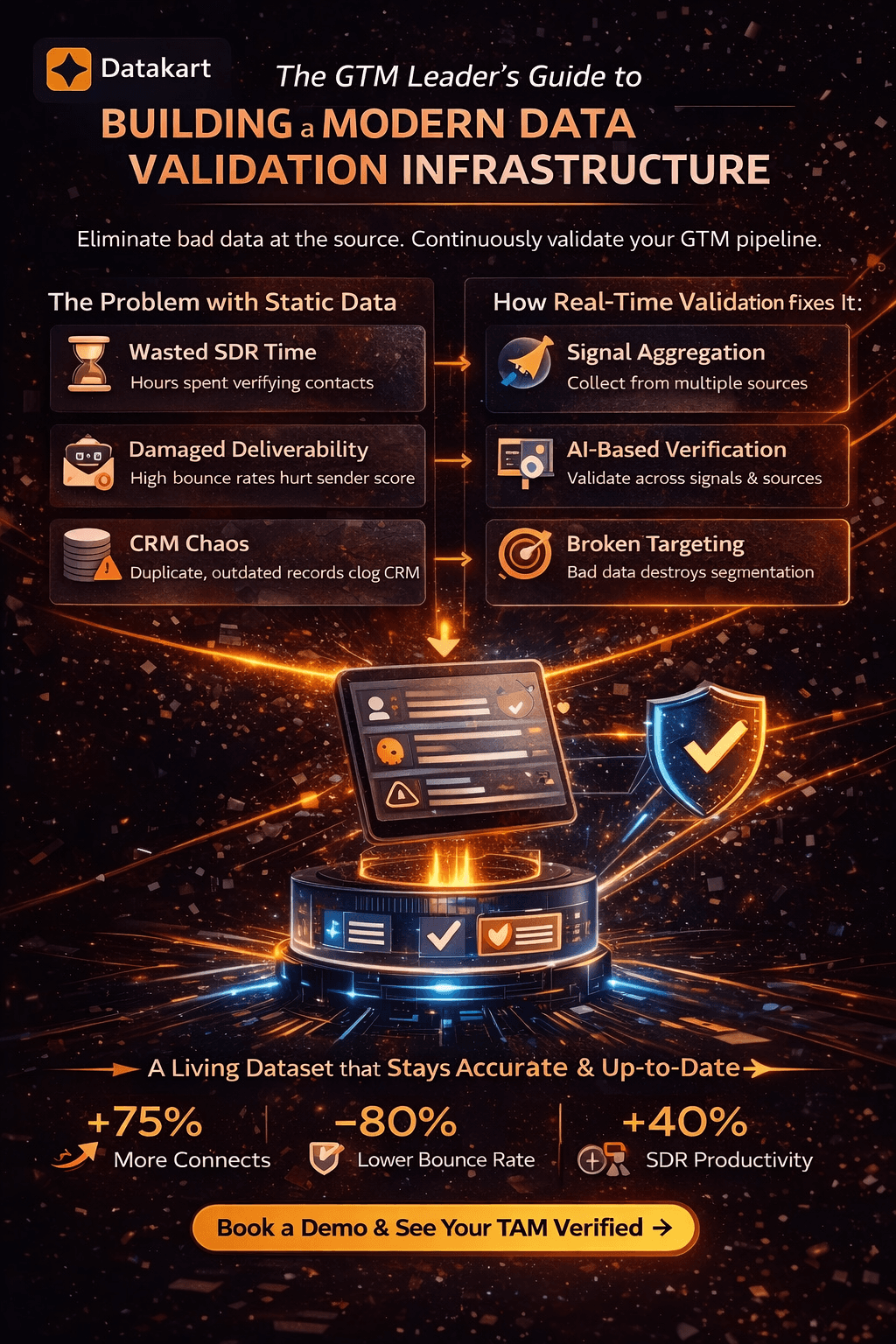
The GTM Leader's Guide to Building a Modern Data Validation Infrastructure
Build a robust data validation infrastructure. Learn to implement real-time verification logic for email and phone checks to fuel your revenue engine.
 March 28th, 2026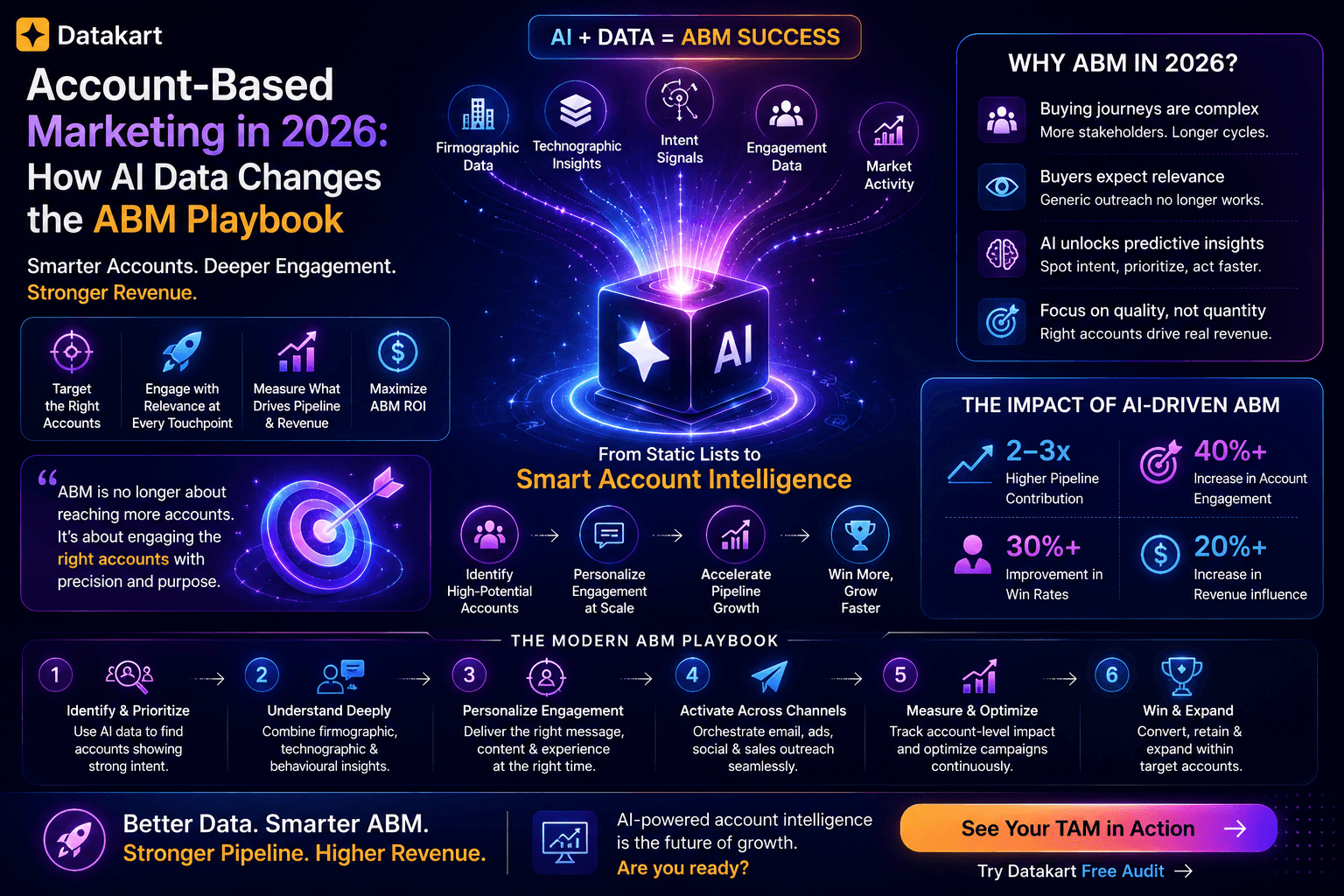
Account-based marketing has significantly evolved over the last few years. What however has changed is previously this would be a highly targeted approach focused on a select group of high-value accounts but now has become an important part of core growth strategy for several B2B organizations making ABM different.
Account-based marketing has significantly evolved over the last few years. What however has changed is previously this would be a highly targeted approach focused on a select group of high-value accounts but now has become an important part of core growth strategy for several B2B organizations making ABM different.
One of the most important causes of this shift is the evolution of artificial intelligence. With the change in buying behavior and the overall journey, there is a change in complexity as well as customer expectations that is continually rising. This is why businesses are turning to AI-driven insights to tap opportunities faster, personalize engagement more effectively, while enhancing overall campaign performance.
With this, one can see that the ABM strategy 2026 is about leveraging real-time data to make smart, effective decisions through product and customer lifestyle.
ABM traditionally was about using static account lists, historical firmographic data, and manual research. Here, the teams would typically reach out to companies by manually researching industry, company size, revenue, or geography and design communication strategy around those selections.
In today’s times ABM has become more dynamic. The buying behavior and journey involves several stakeholders, has longer evaluation cycles, and multiple digital touchpoints. With focus on signals that indicate account readiness, engagement levels, technology adoption, organizational changes, and buying intent, ABM strategy 2026 taps accounts that surely will convert.
Artificial intelligence has become very important in today’s times with it powering next-generation account targeting and engagement. AI ABM enables businesses to evaluate large volumes of account data that otherwise would be difficult for teams to manually process. AI also helps look for patterns across customer behavior, engagement activity, firmographic information, technographic data, and intent signals to uncover opportunities that might otherwise be missed.
The success of ABM data 2026 relies on gathering the right information and acting upon them.
This is where AI helps by:
Identifying accounts that shows active buying signals
Prioritizing accounts that are likely to convert
Looking for changes within target organizations
Searching for hidden opportunities within existing accounts
Recommending next-best actions for engagement
Enhancing account scoring accuracy
Revenue teams can benefit from using AI-driven insights on current market activity and real time behavior of target customers than assume anything manually.
This is one of the primary reasons why account based marketing AI is becoming an important tool in modern go-to-market strategies.
One of the most significant elements of the ABM program is the selection of accounts along with extensive research and dependency on subjective criteria.
Organizations also focus on incorporating behavioral and predicative data in the selection process than just go for static ICP definitions. This allows businesses to assess several companies together while demonstrating active buying intent.
With an effective AI-powered ABM approach, several data sources can be combined to enable businesses to create ever evolving account bases. Different data that can be combined include:
Firmographic data
Technographic information
Engagement signals
Intent data
CRM history
Market activity
Platforms that centralize account intelligence and enrichment data can further improve account selection by ensuring teams work with accurate and up-to-date information.
Personalization is very important when it comes to ABM but more important is providing desired experience across accounts.
Organizations can now personalize engagement on a large scale with help of modern ABM playbook that evaluates account attributes, engagement history, content consumption patterns, and buying signals that helps marketing teams to:
• Define more customized messaging for different account segments
• Provide relevant content experiences
• Send personalized outreach campaigns
• Assist sales teams with account-specific insights
• Enhance timing and channel selection
AI isn’t about replacing human creativity but enabling teams to scale personalization, maintain relevance thereby enabling organizations to engage more accounts without compromising on customer experience.
Effectiveness of ABM programs can be measured with methods that are more account centric than just focusing on lead volume. Different metrics can be assessed by connecting engagement signals across channels and identifying which activities contribute most to account movement, enabling more accurate assessment of ABM performance and ROI:
Here following aspects can be assessed:
• Account engagement levels
• Buying committee activity
• Pipeline contribution
• Opportunity creation
• Account progression
• Revenue influence
• Customer expansion
Account-based marketing is entering a new phase where data quality, predictive intelligence, and automation play a larger role than ever before. The organizations achieving the strongest results are not necessarily targeting more accounts; they are targeting the right accounts with greater precision.
By combining high-quality account intelligence with AI-powered ABM capabilities offered by brands like DataKart, businesses can identify opportunities earlier, personalize engagement more effectively, and measure performance with greater accuracy. As buying journeys continue to evolve, the most successful modern ABM playbook will be one that uses AI not simply to automate tasks, but to make every account decision smarter.
ABM strategy 2026 refers to the next generation of account-based marketing that combines AI, real-time data, intent signals, and automation to improve account targeting, engagement, and revenue outcomes.
AI helps identify high-potential accounts, prioritize opportunities, personalize outreach, analyze engagement patterns, and improve campaign performance through data-driven insights.
AI-powered ABM uses artificial intelligence to automate and optimize account selection, targeting, personalization, and measurement across the buyer journey.
ABM data 2026 provides the intelligence needed to understand account behavior, buying intent, engagement activity, and revenue opportunities in real time.
A successful modern ABM playbook combines accurate data, AI-driven insights, sales and marketing collaboration, personalized engagement, and account-focused measurement strategies.
Build a robust data validation infrastructure. Learn to implement real-time verification logic for email and phone checks to fuel your revenue engine.
March 28th, 2026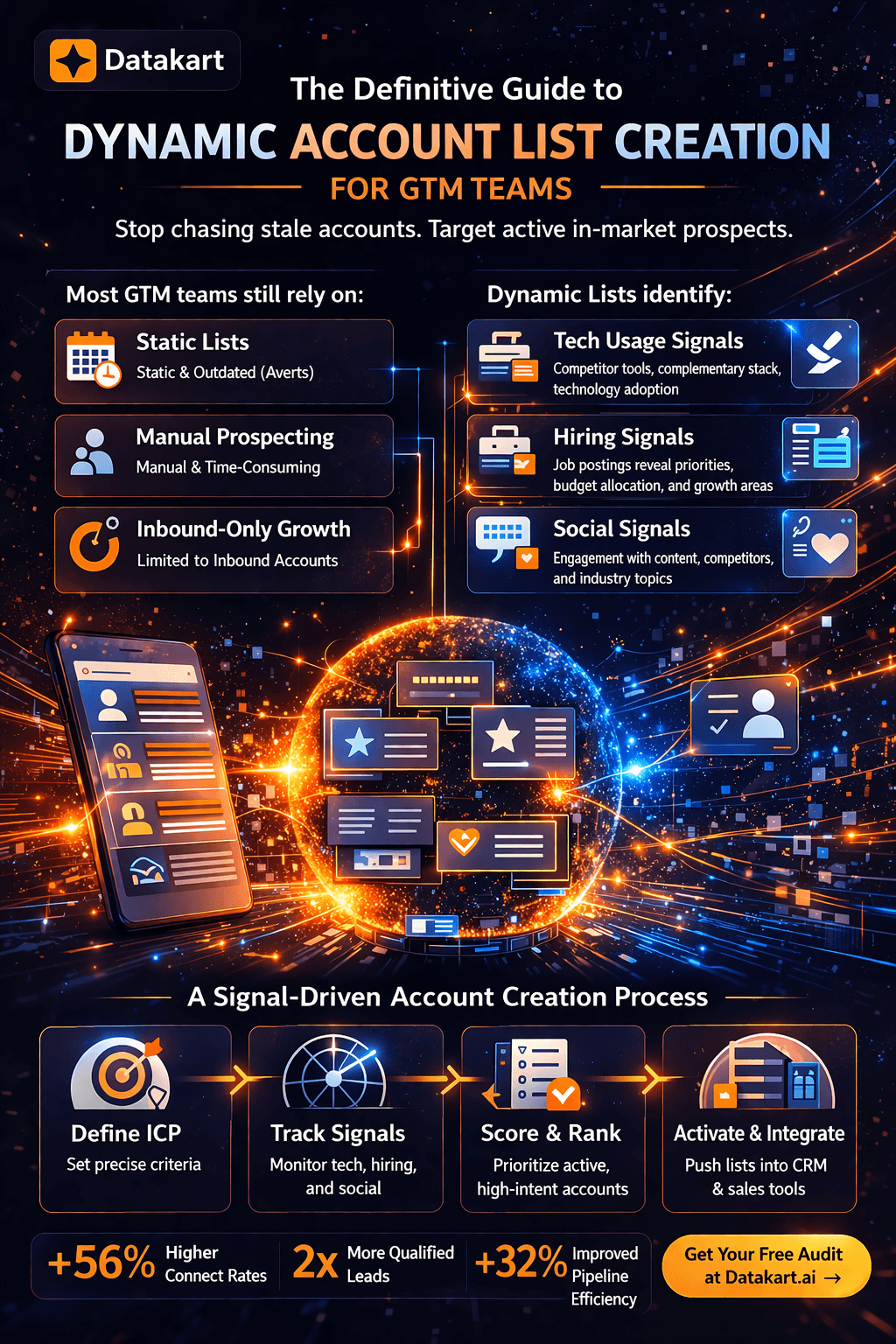
Stop wasting budget on stale data. Learn a step-by-step framework for account list creation using tech, hiring, and social signals for a high-precision GTM strategy.
March 28th, 2026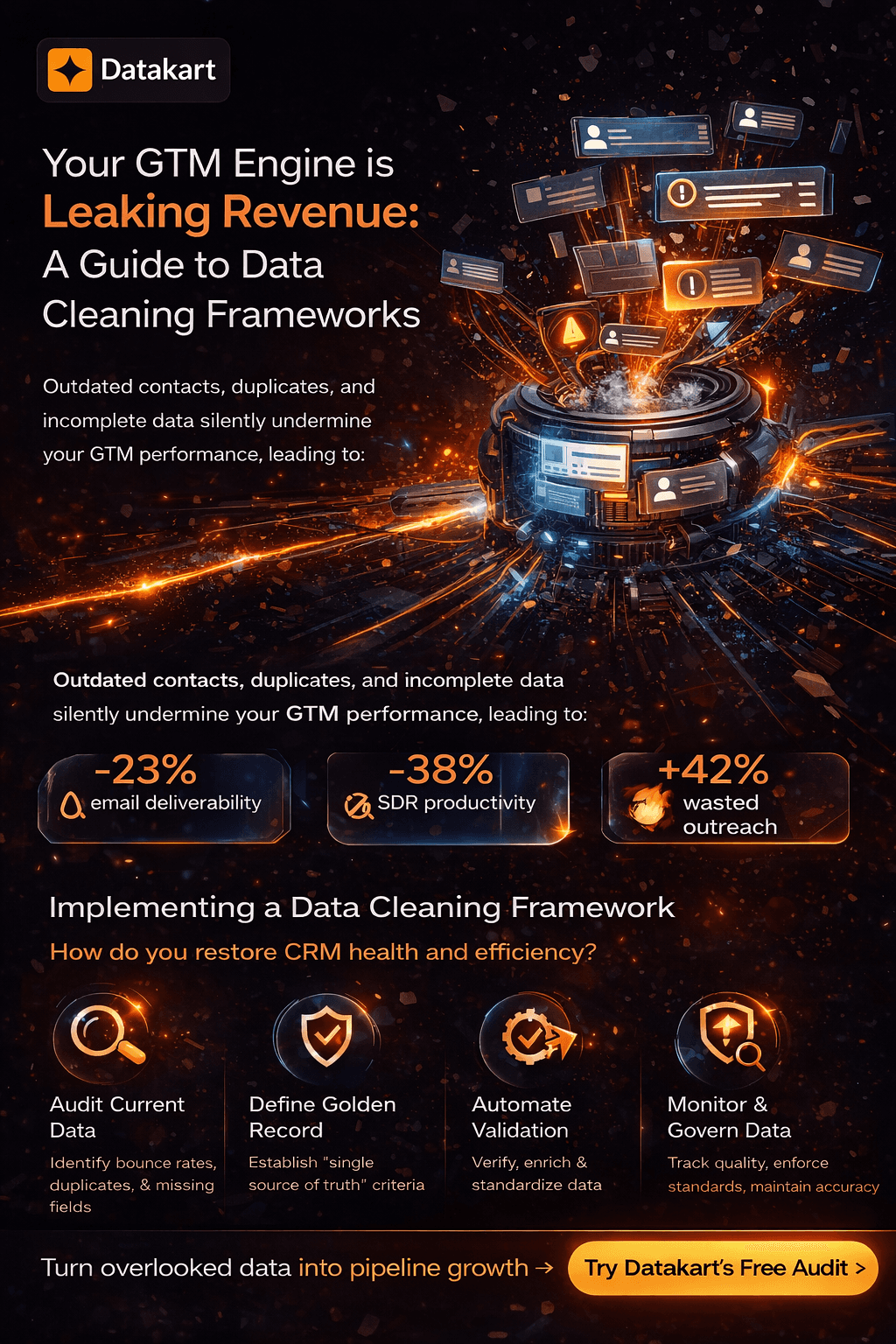
Stop losing revenue to bad data. Learn how scalable data cleaning frameworks help RevOps and GTM leaders build a reliable pipeline engine.
March 21st, 2026