
The GTM Leader's Guide to Building a Modern Data Validation Infrastructure
Build a robust data validation infrastructure. Learn to implement real-time verification logic for email and phone checks to fuel your revenue engine.
 March 28th, 2026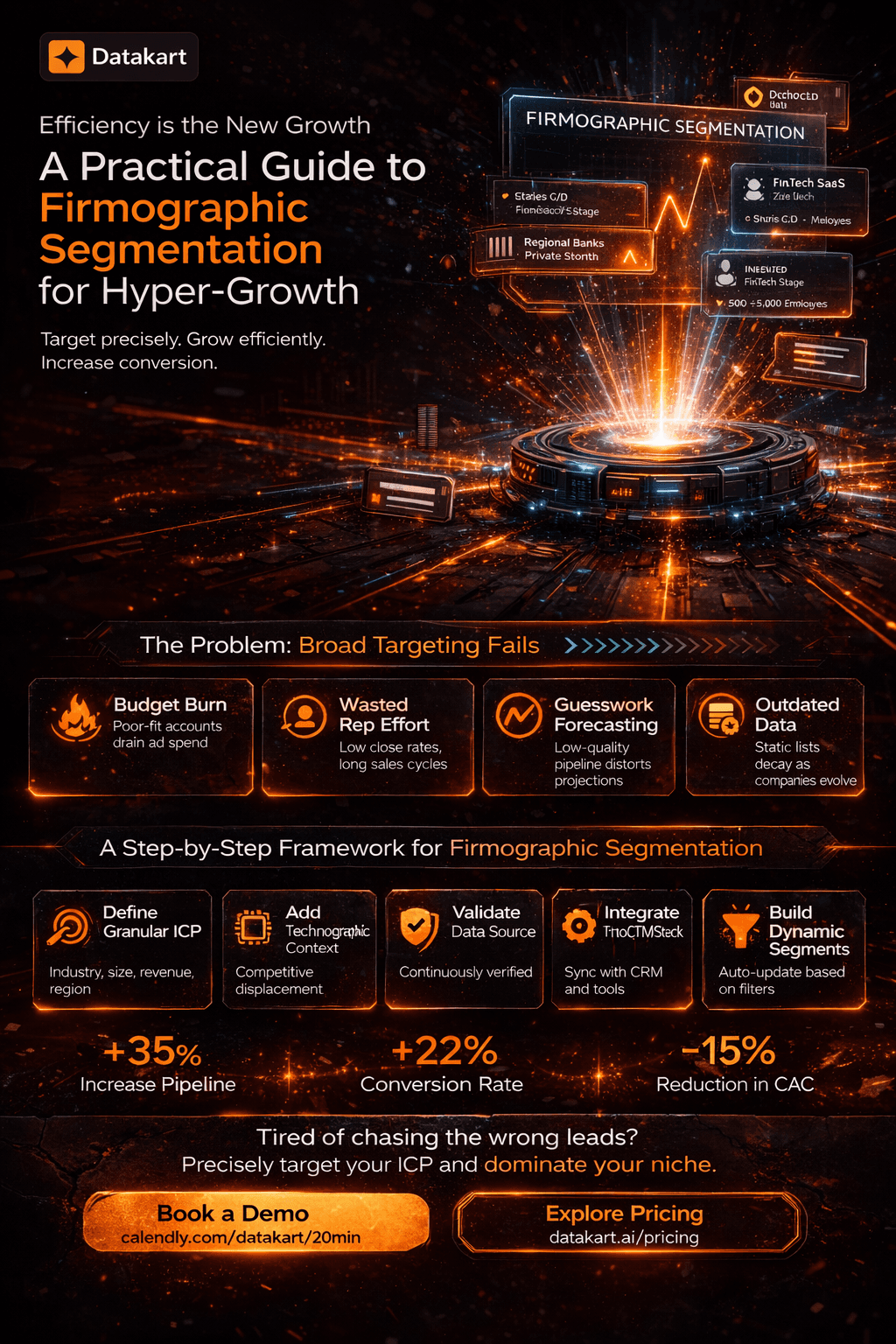
Unlock precision B2B targeting with firmographic segmentation. Use industry, company size, and revenue filters to find your best-fit customers.
Efficiency is the new growth.
In today’s market, every GTM decision is under scrutiny. Budget allocation, pipeline quality, and sales productivity are all being measured more closely than ever.
Yet many teams still target too broadly, assuming volume will compensate for lack of precision.
It doesn’t.
The difference between a high-performing GTM engine and a struggling one often comes down to a single capability.
How effectively you segment your market.
This is where firmographic segmentation becomes a true competitive advantage.
Most GTM teams do not fail because they lack leads.
They fail because they pursue the wrong ones.
Budget Is Wasted on Poor-Fit Accounts
Marketing campaigns target companies that appear relevant but lack the budget, scale, or need to convert.
Sales Cycles Become Longer
Sales teams spend time on accounts that never close, leading to slower cycles and reduced efficiency.
Forecasting Becomes Unreliable
When pipeline quality is low, projections become inaccurate and difficult to trust.
Data Decay Reduces Accuracy
Firmographic data changes constantly. Companies grow, shrink, pivot, or get acquired.
Without continuous updates, segmentation becomes outdated quickly.
The result is consistent.
Low conversion rates, wasted effort, and increasing customer acquisition costs.
High-performing GTM teams do not rely on basic segmentation.
They build multi-dimensional firmographic models powered by continuously verified data.
Instead of simply identifying companies that fit an Ideal Customer Profile, they prioritize those that match the profile in real time and show the highest likelihood to convert.
Platforms like Datakart’s GTM intelligence platform enable this approach by providing accurate, continuously updated firmographic data.
Key capabilities include:
Granular Industry Classification
Segmentation moves beyond broad categories to highly specific verticals such as regional commercial banking or private equity.
Real-Time Company Size Tracking
Employee counts reflect current scale rather than outdated estimates.
Dynamic Revenue Bands
Financial indicators are updated regularly to assess deal potential accurately.
Continuous Verification
Data evolves alongside the market instead of being refreshed periodically.
This transforms segmentation from static filtering into a dynamic targeting system.
Effective firmographic segmentation requires a structured and data-driven approach.
The process begins with defining a granular Ideal Customer Profile. Rather than broad categories, organizations should specify attributes such as industry vertical, company size, revenue range, geographic region, and growth stage.
Technographic data should then be layered on top of firmographics. Understanding which tools a company uses provides insight into integration opportunities, competitive positioning, and overall maturity.
Data quality must be validated before segmentation is applied. Reliable segmentation depends on verified, frequently updated data sources. Without this foundation, even well-designed segmentation models fail.
Integration into the GTM stack is critical. Firmographic data should flow directly into CRM systems, marketing automation platforms, and sales engagement tools to enable real-time targeting.
CTA: Want to see your TAM in action? Try Datakart’s Free Audit.
Dynamic segmentation should replace static lists. Segments must update automatically based on criteria such as ICP alignment, revenue bands, industry filters, and growth signals.
Personalization should follow segmentation. Messaging must adapt to factors such as company size, industry-specific challenges, and growth stage to improve engagement.
Finally, segmentation performance should be measured continuously. Metrics such as win rates, deal size, sales cycle length, and customer acquisition cost provide insight into which segments perform best and where refinement is needed.
A FinTech SaaS company initially targeted the entire financial services sector.
This broad approach resulted in low-quality leads, an eight percent MQL-to-SQL conversion rate, and high customer acquisition costs.
After refining their firmographic segmentation, the company narrowed its focus to regional banks and private equity firms with specific size and revenue characteristics, while also incorporating technographic insights.
The results were significant.
• Pipeline increased by 35 percent
• Conversion rates improved to 22 percent
• Customer acquisition cost decreased by 15 percent
The improvement came from precision rather than increased volume.
Several common mistakes limit the effectiveness of firmographic segmentation.
Relying on a single filter such as company size reduces accuracy. Effective segmentation requires multiple dimensions.
Using overly broad industry categories limits relevance. Narrower segments drive better results.
Ignoring data freshness leads to outdated targeting. Continuous verification is essential.
Misalignment between sales and marketing teams reduces execution quality. Both teams must operate from a shared segmentation framework.
A strong segmentation strategy depends on a well-structured GTM stack.
CRM systems such as Salesforce or HubSpot act as the system of record where segmentation is applied.
The intelligence layer powers segmentation.
Platforms like Datakart’s data intelligence platform provide accurate firmographic data, continuous updates, and deep segmentation capabilities.
Execution tools such as sales engagement and marketing automation platforms activate these insights.
Organizations evaluating this approach often review Datakart’s pricing and enrichment plans to understand how advanced segmentation fits into their GTM strategy.
The core principle is clear: better data leads to better segmentation, which drives stronger pipeline outcomes.
The era of broad targeting is over.
Modern GTM teams succeed by narrowing their focus, improving data quality, and acting on precise segments.
Firmographic segmentation is not simply a filtering mechanism. It is a strategic capability.
When executed effectively, it increases conversion rates, reduces customer acquisition costs, shortens sales cycles, and creates a more predictable pipeline.
Precision is no longer optional. It is required for scalable growth.
Ready to improve your targeting strategy?
Discover how advanced firmographic segmentation can transform your pipeline. Book a 30-minute discovery call with the Datakart team or explore Datakart’s pricing and enrichment plans to get started.
What is firmographic segmentation?
Firmographic segmentation is the process of grouping companies based on attributes such as industry, size, revenue, and location to improve targeting.
Why are revenue bands important?
Revenue bands help identify companies with the financial capacity and deal potential aligned with your offering.
How granular should industry filters be?
Industry filters should be as specific as possible to improve relevance and conversion rates.
Why does company size matter?
Company size indicates organizational complexity, buying power, and the nature of the sales process.
How often should data be refreshed?
Data should be refreshed continuously to maintain accuracy and ensure effective targeting.
Build a robust data validation infrastructure. Learn to implement real-time verification logic for email and phone checks to fuel your revenue engine.
March 28th, 2026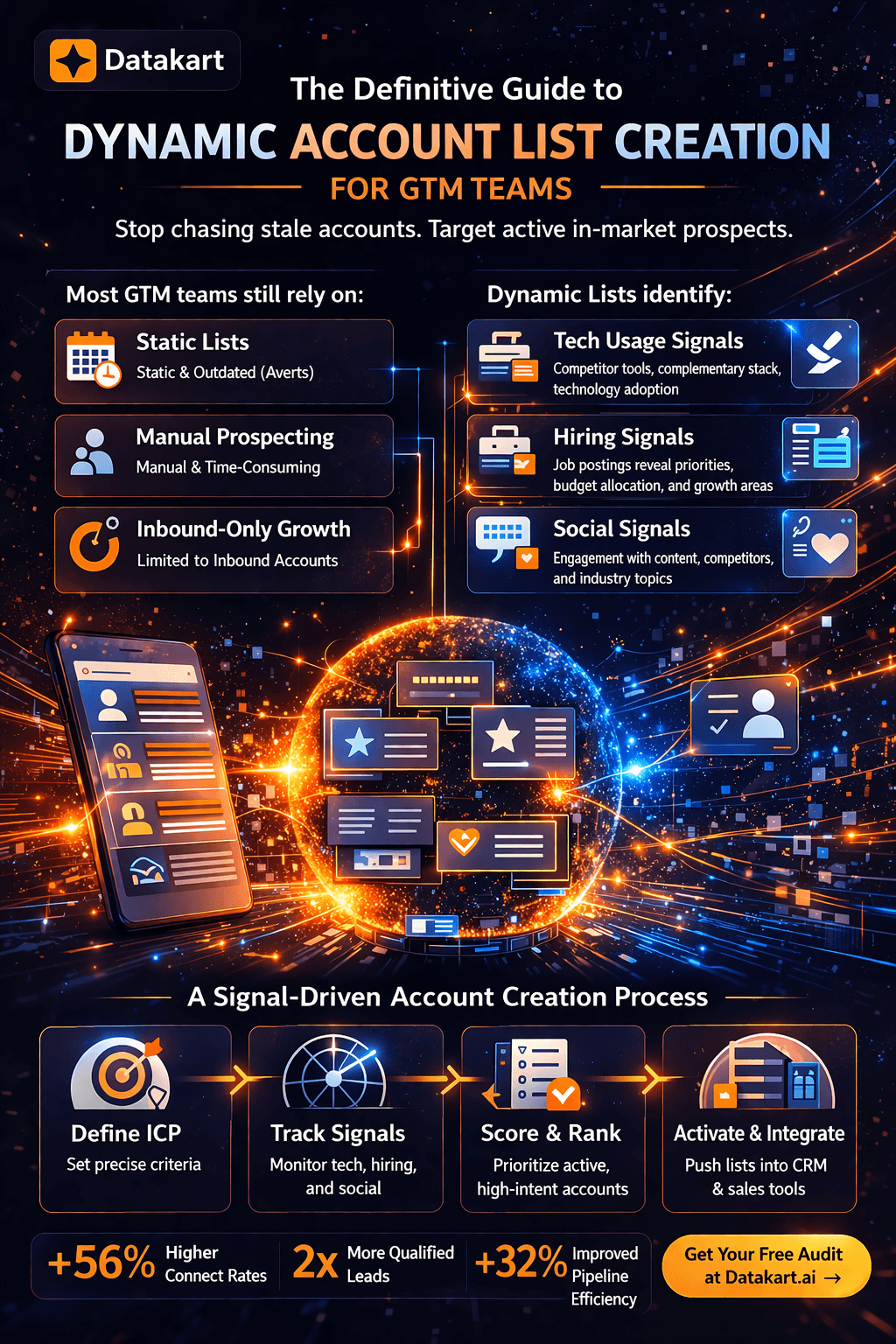
Stop wasting budget on stale data. Learn a step-by-step framework for account list creation using tech, hiring, and social signals for a high-precision GTM strategy.
March 28th, 2026
Stop losing revenue to bad data. Learn how scalable data cleaning frameworks help RevOps and GTM leaders build a reliable pipeline engine.
March 21st, 2026