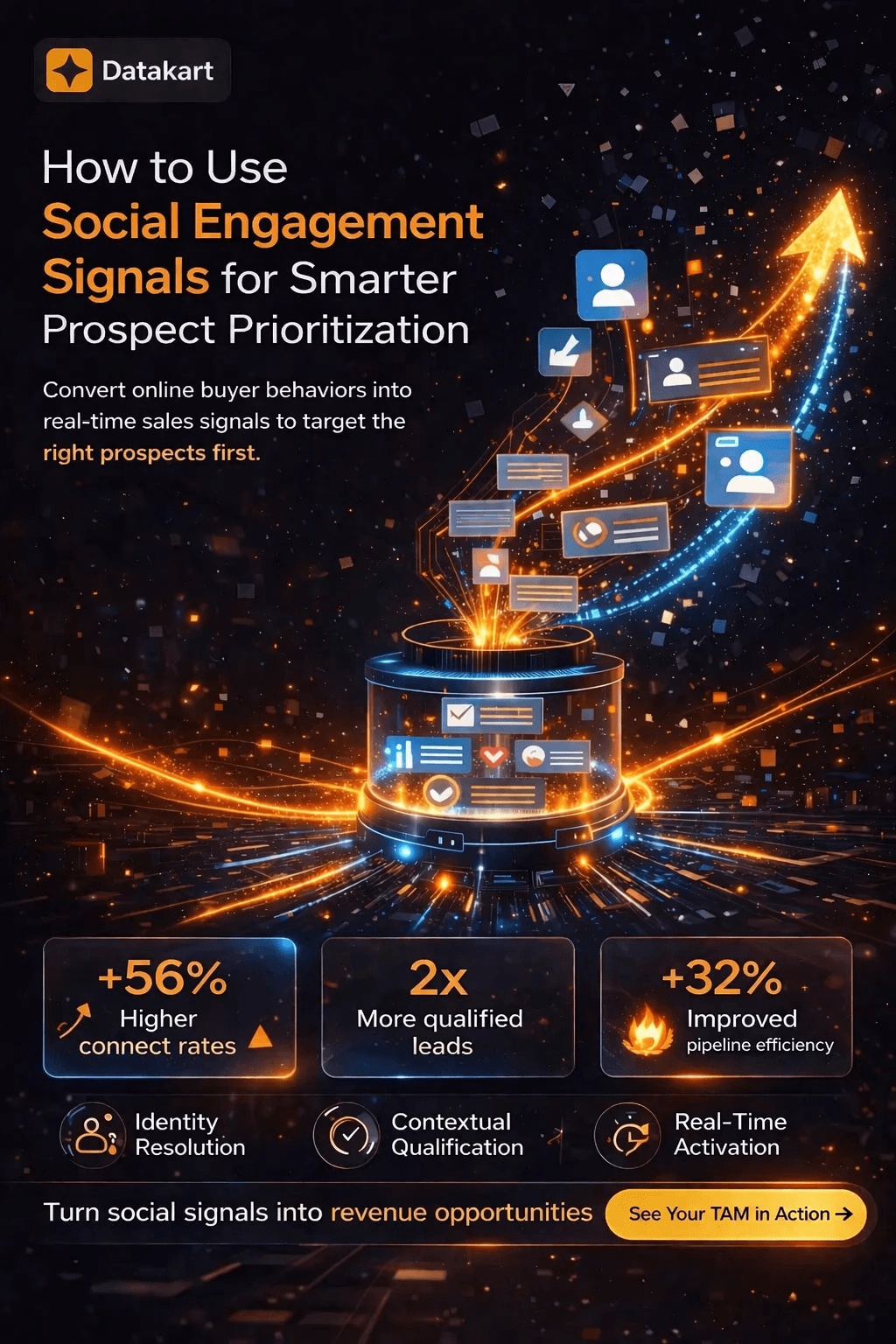
How to Use Social Engagement Signals for Smarter Prospect Prioritization
Stop wasting time on cold leads. Learn how social engagement signals and verified data reveal buying intent and improve prospect prioritization.
 March 19th, 2026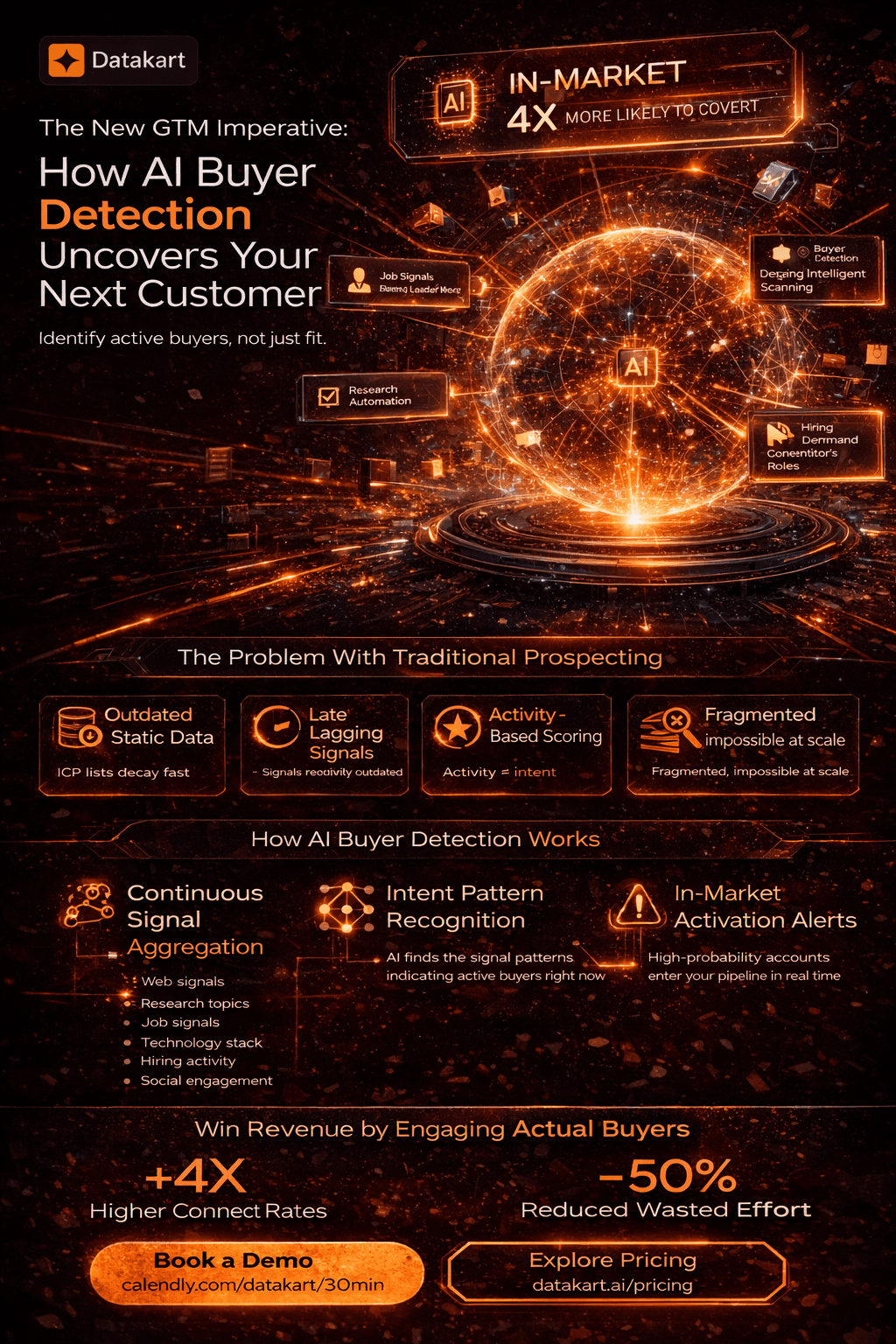
Stop chasing cold leads. Learn how AI buyer detection uses behavioral scoring and activity scanning to find in-market buyers before your competitors.
Your Total Addressable Market is not a static spreadsheet.
It is a living system of companies, people, and constantly changing priorities.
But most of your market is not ready to buy.
Nearly all outbound effort is spent chasing prospects with zero intent, while competitors focus on the small percentage actively evaluating solutions.
This is the gap.
The traditional GTM playbook of buying lists, blasting sequences, and hoping for replies no longer works. It is inefficient, expensive, and increasingly ignored.
The real question today is not who fits your ICP.
It is who is actively in-market right now.
This is where AI buyer detection changes everything.
Most GTM teams operate with outdated signals and flawed assumptions.
They are not targeting buyers. They are chasing noise.
Static Data Creates Blind Spots
Lists become outdated immediately. Contacts change roles, companies evolve, and data decays faster than teams can react.
You are working with yesterday’s reality.
Lagging Signals Kill Timing
Funding announcements and job changes are already late signals. By the time they appear, competitors are already engaged.
You are reacting instead of leading.
Lead Scoring Misses Intent
Traditional scoring models prioritize activity rather than intent.
A content download does not mean a buyer is evaluating solutions. Often, it signals early-stage research.
This disconnect creates friction between marketing and sales.
Manual Prospecting Does Not Scale
Tracking signals across platforms such as LinkedIn, job boards, and content sites manually is not feasible.
Early intent signals are missed, and opportunities are lost.
The outcome is predictable.
Low connect rates, poor conversion, and wasted effort.
The shift is straightforward but powerful.
From static data to real-time behavior.
Instead of identifying who could buy, you identify who is ready to buy.
This is what AI buyer detection enables.
Continuous Activity Scanning
AI systems monitor millions of signals across the web.
• Job postings
• Content consumption
• Social engagement
• Technology changes
• Review platforms
This process runs continuously rather than periodically.
Pattern Recognition Across Signals
Intent is not defined by a single action.
It is defined by patterns.
A company hiring RevOps leaders, researching tools, and engaging with relevant content signals a buying cycle.
AI connects these signals into a single, actionable insight.
Behavioral Scoring That Adapts
Not all actions carry equal weight.
• Pricing page visits indicate high intent
• Blog views indicate low intent
AI assigns value based on real buying behavior and continuously refines scoring.
This creates a dynamic prioritization engine.
The result is simple.
You engage buyers at the exact moment it matters most.
Operationalizing AI buyer detection requires a structured approach.
The process begins with clearly defining your Ideal Customer Profile. Go beyond firmographics and identify the real triggers that indicate buying intent, such as hiring patterns, technology changes, or operational shifts.
Next, map your Total Addressable Market into a dynamic platform. This creates a monitored ecosystem where signals can be tracked continuously.
Relevant signals must then be configured. Focus on behaviors that directly correlate with buying intent in your category.
Establish a behavioral scoring threshold that defines when an account is ready for engagement. This threshold should be based on a combination of signals rather than a single action.
CTA: Want to see your TAM in action? Try Datakart’s Free Audit.
Signal data should then be integrated into your workflows. High-intent accounts must automatically trigger actions within your CRM and sales tools.
Finally, equip your sales team with context. Outreach should be driven by relevance, referencing real signals such as hiring activity or operational changes.
This transforms generic outreach into meaningful engagement.
A SaaS company offering marketing automation solutions struggled with low connect rates and inefficient pipeline generation.
Their initial approach relied on large cold lists with minimal context.
After adopting AI buyer detection, they shifted to targeting accounts showing strong intent signals.
These included companies hiring demand generation roles, switching from competitor tools, and consuming content related to automation and account-based marketing.
Each SDR received a smaller, high-intent list with clear context for outreach.
The results were immediate.
• Connect rates increased significantly
• Meeting conversion improved
• Sales cycles shortened
The company did not change its product or team.
It improved timing and relevance.
Treating AI buyer detection as a static list undermines its effectiveness. Signals are dynamic and require continuous updates.
Ignoring signal context reduces impact. Understanding why an account is active is critical for personalization.
Misalignment between sales and marketing creates inconsistency. Both teams must operate from shared definitions of intent.
Failing to refine signals over time leads to decay. Continuous optimization is required.
AI buyer detection enhances your existing GTM stack rather than replacing it.
Your CRM remains the system of record.
Your engagement tools serve as the execution layer.
Your data platform becomes the intelligence engine.
Platforms like Datakart’s GTM intelligence platform integrate directly into workflows, delivering verified, high-intent signals into your pipeline.
Organizations often evaluate Datakart’s pricing and enrichment plans to understand how real-time intelligence supports their GTM strategy.
The result is a system where teams operate with current, actionable insights.
The most valuable advantage in modern GTM is not volume.
It is timing.
AI buyer detection shifts your strategy from chasing the market to engaging buyers at the right moment.
Instead of increasing activity, you improve outcomes.
Instead of guessing, you operate with clarity.
This is the difference between pipeline that appears busy and pipeline that converts.
Ready to stop chasing cold leads and start engaging real buyers?
Discover how AI-driven intelligence can transform your pipeline. Book a 30-minute demo with the Datakart team and see how real-time signals drive better results.
What is AI buyer detection?
AI buyer detection identifies in-market buyers by analyzing behavioral patterns across multiple external data sources in real time.
How is it different from traditional lead scoring?
Traditional lead scoring relies on internal engagement data. AI buyer detection analyzes external signals across the web, providing earlier and more accurate intent identification.
What signals does it track?
Signals include hiring activity, technology stack changes, content engagement, social activity, and competitor interactions.
Can it integrate with existing tools?
Yes, platforms like Datakart integrate with CRM and sales tools, enabling seamless activation within existing workflows.
Stop wasting time on cold leads. Learn how social engagement signals and verified data reveal buying intent and improve prospect prioritization.
March 19th, 2026
Master intent data to engage prospects at the right moment, personalize outreach, and accelerate pipeline growth.
October 5th, 2025
Mid-market sales prospecting has fundamentally shifted. Discover the new playbook — from AI-assisted outreach and buying committee mapping to intent data and hyper-personalization — that top-performing teams are using to break through the noise.
February 26th, 2026