
The Ultimate Guide to B2B Intent Data in 2025
Master intent data to engage prospects at the right moment, personalize outreach, and accelerate pipeline growth.
 October 5th, 2025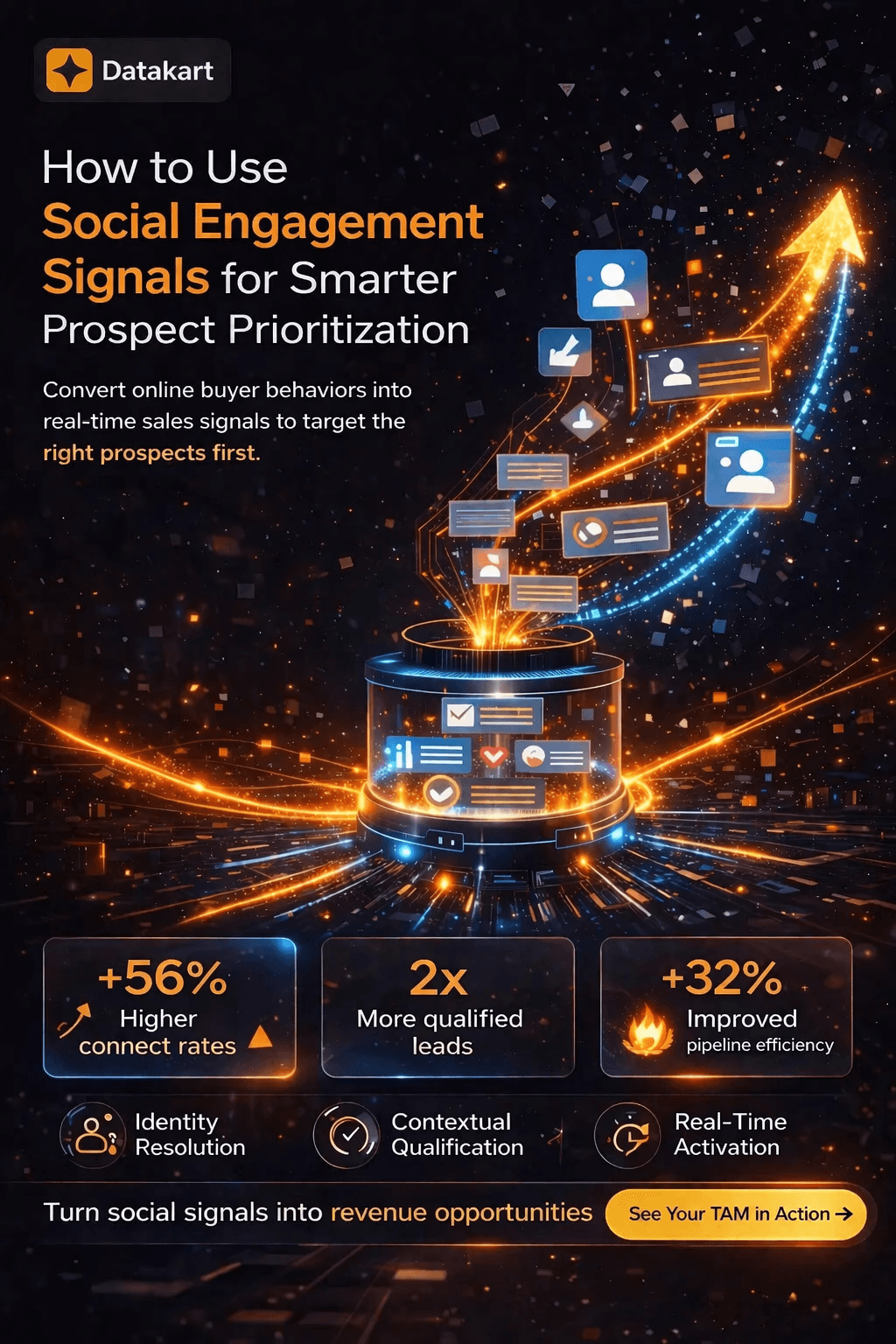
Stop wasting time on cold leads. Learn how social engagement signals and verified data reveal buying intent and improve prospect prioritization.
GTM teams today face a data paradox: an abundance of contacts but a lack of actionable insight. CRMs are full, marketing pipelines are active, yet SDRs still struggle with low connect rates and inefficient outreach.
The core issue is reliance on outdated intent signals.
Modern buyers conduct the majority of their research independently across platforms like LinkedIn and industry communities. During this process, they generate social engagement signals, observable behaviors that indicate interest, intent, and urgency.
These signals represent real-time insight into audience behavior, making them significantly more valuable than traditional lead scoring models.
Most GTM strategies still rely on static workflows built around list acquisition and MQL generation.
This approach has several structural limitations.
Lagging Intent Signals
Form fills and content downloads indicate interest, but they occur late in the buying journey. By this stage, buyers have already evaluated multiple vendors.
Data Decay and Inaccuracy
Contact data becomes outdated rapidly due to job changes and company shifts. Static datasets lead to wasted outreach efforts and lower conversion rates.
Lack of Contextual Insight
Traditional systems capture actions but not intent. A pricing page visit provides limited insight compared to a detailed public discussion about a specific business problem.
According to Gartner’s research on the B2B buying journey, buyers spend a significant portion of their journey independently researching before engaging vendors. This reinforces the importance of identifying early-stage signals rather than relying on late-stage conversions.
Social signals alone are not sufficient. They must be converted into actionable data.
Platforms like Datakart’s B2B data platform enable this transition by connecting behavioral signals with verified identity data.
This introduces three key capabilities.
Identity Resolution
Anonymous or partial profiles are mapped to verified individuals with accurate job titles, company information, and contact details.
Contextual Qualification
Signals are evaluated against ICP criteria, allowing teams to determine whether a prospect fits their target segment.
Real-Time Data Activation
Enriched profiles are pushed into CRM and engagement tools, enabling immediate follow-up based on live intent signals.
This creates a direct pipeline from interaction patterns to revenue opportunities.
Effective use of social engagement signals requires a structured approach.
The first step is defining what constitutes meaningful intent. Not all engagement carries equal weight. Passive actions such as likes provide minimal insight, while direct questions or problem discussions indicate strong buying intent.
Next, GTM teams must identify where their target audience is active. This includes influencer content, competitor pages, and niche industry communities where relevant conversations occur.
Monitoring systems should then be implemented to capture these signals consistently. This may involve social listening tools or dedicated workflows.
Once signals are captured, they must be enriched with verified data. Without identity resolution, signals remain non-actionable.
CTA: Want to see your TAM in action? Try Datakart’s Free Audit.
After enrichment, leads should be scored based on intent level, role seniority, and ICP alignment. High-intent prospects should be prioritized for immediate outreach.
Automation ensures speed. Signals should trigger workflows that assign leads, create tasks, and provide SDRs with contextual information for engagement.
Finally, performance should be continuously measured. Metrics such as connect rate, meeting conversion, and pipeline contribution validate the effectiveness of this approach.
A SaaS company targeting finance leaders faced persistent challenges with outbound efficiency. Their SDR team relied on static contact lists and experienced low engagement rates.
They shifted their strategy to focus on social engagement signals.
The team began monitoring discussions around financial planning challenges on LinkedIn. When relevant engagement was identified, profiles were enriched using verified data.
Outreach was then executed with contextual messaging tied directly to the observed signal.
This resulted in measurable improvements.
• Higher connect rates due to accurate contact data
• Improved response rates driven by contextual messaging
• Increased pipeline conversion from high-intent prospects
The improvement was driven by signal relevance rather than increased outreach volume.
Several common issues reduce the effectiveness of signal-based prospecting.
Focusing on low-value engagement signals leads to poor prioritization. High-intent signals must be clearly defined and prioritized.
Failing to verify data results in incomplete or inaccurate outreach. Identity resolution is essential for converting signals into leads.
Delayed follow-up reduces effectiveness. Social signals represent time-sensitive intent and require rapid response.
Using generic messaging undermines the value of signal-based targeting. Outreach must reference specific behaviors to remain relevant.
A functional GTM stack for signal-based prospecting includes three core layers.
Signal discovery tools identify relevant engagement across digital channels.
Data platforms such as Datakart’s real-time enrichment platform convert signals into verified, actionable contact data.
Execution systems such as CRM and sales engagement tools activate outreach workflows.
Organizations evaluating this approach often review Datakart’s pricing and data plans to determine how data infrastructure supports scalable prospect prioritization.
Modern GTM success depends on identifying and acting on real-time buyer intent.
Social engagement signals provide early insight into prospect needs, enabling teams to prioritize outreach based on actual behavior rather than static assumptions.
When combined with verified data and automated workflows, these signals transform prospecting into a precision-driven process.
The result is improved efficiency, higher conversion rates, and stronger pipeline performance.
To evaluate how effectively your team captures and activates buying signals, book a 30-minute demo with Datakart and analyze your current data infrastructure.
What are social engagement signals in B2B?
They are observable actions taken by prospects on digital platforms that indicate interest or intent, such as commenting, sharing, or engaging in industry discussions.
How do you use these signals for lead prioritization?
Signals are captured, enriched with verified data, scored based on intent and ICP fit, and routed for targeted outreach.
Why is data verification important in this process?
Verification ensures that engagement signals are tied to accurate identities and contact information, enabling effective follow-up.
Can social signals indicate buying intent?
High-intent engagement patterns, such as asking detailed questions about a problem or solution, are strong indicators of early-stage buying intent.
Master intent data to engage prospects at the right moment, personalize outreach, and accelerate pipeline growth.
October 5th, 2025
Mid-market sales prospecting has fundamentally shifted. Discover the new playbook — from AI-assisted outreach and buying committee mapping to intent data and hyper-personalization — that top-performing teams are using to break through the noise.
February 26th, 2026
Static contact lists are obsolete. Discover the top B2B data trends for 2026, from AI-driven verification to dynamic data sourcing, and future-proof your GTM strategy.
March 16th, 2026