
How to Use Social Engagement Signals for Smarter Prospect Prioritization
Stop wasting time on cold leads. Learn how social engagement signals and verified data reveal buying intent and improve prospect prioritization.
 March 19th, 2026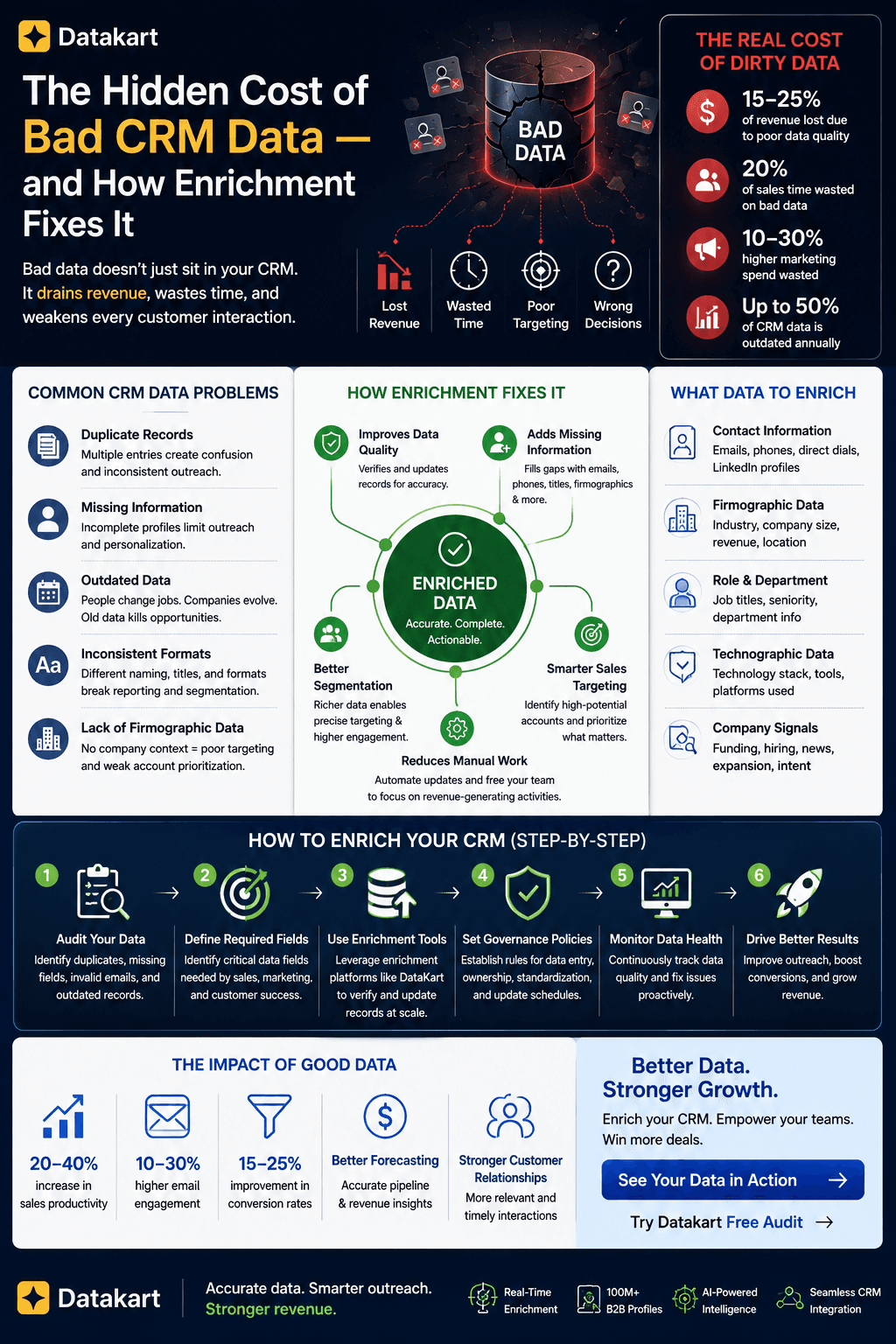
Customer Relationship Management (CRM) systems are specifically designed to enable businesses to manage their customer interactions effectively, streamline sales processes, and drive revenue growth. The success of a CRM system depends on the contact data it has in the system. A CRM system that has outdated records, incomplete data, or records that are duplicated or inaccurate pose several challenges to business owners with its own effects on revenue and productivity.
Customer Relationship Management (CRM) systems are specifically designed to enable businesses to manage their customer interactions effectively, streamline sales processes, and drive revenue growth. The success of a CRM system depends on the contact data it has in the system. A CRM system that has outdated records, incomplete data, or records that are duplicated or inaccurate pose several challenges to business owners with its own effects on revenue and productivity.
The bad CRM data cost goes beyond operational inefficiencies affecting sales performance, marketing effectiveness, customer experience, and decision-making. With businesses continuously relying on data-driven strategies, it is essential to maintain the accuracy of CRM records with help of data enrichment.
Bad CRM data is that data in a CRM system which is incorrect, outdated, incomplete, duplicated, or inconsistent.
Over a period of time, customer and company information undergo changes. Contact points switch jobs and roles. There is a growth in businesses. All these result in the email ids as well as phone numbers becoming inactive while the technology stacks evolve. This is why it is essential to periodically update CRM databases to retain data accuracy.
Few examples of poor CRM data quality include:
Incomplete contact details
Invalid email addresses
Presence of duplicate records
Outdated job titles
Incorrect company information
Inconsistent formatting
Missing firmographic data
Incomplete customer profiles
Although these issues may appear negligible at an individual level, they can come with its own challenges when multiplied across thousands of records.
Most organizations do not have a proper estimate of the financial and operational impact of poor data management.
Sales teams often rely on accurate contact information without outdated or invalid email ids and phone numbers to engage prospects. Connecting with the wrong person or not having the correct details can result in delays in conversation, thus mining conversion rates.
Marketing campaign performance also depends on targeting the right base. A database that has incomplete or inaccurate records when targeted provides lower engagement rates and wasted advertising spend. This increases the cost of bad data B2B operations than expected.
Sales and marketing professionals often spend time verifying records, updating contact details, and searching for missing information.
Businesses must focus on revenue-generating activities rather than manual data clean-up tasks.
Customers look for CRM systems that have relevant records and can be personalized to ensure trust is retained without negatively impacting customer relationships.
Leadership teams depend on CRM insights to make informed decisions. In the presence of records that are inaccurate, or there are incorrect forecasts, performance reports, and market analyses, CRM systems become unreliable resulting in flawed decisions and long-term business risks.
Most organizations encounter similar data quality challenges.
Multiple records for the same company or contact create confusion and make it difficult to maintain a single source of truth.
Duplicates can also lead to repeated outreach and inconsistent customer experiences.
Incomplete profiles limit a team's ability to engage prospects effectively.
Common missing fields include:
Email addresses
Phone numbers
Job titles
Department information
LinkedIn profiles
People frequently change companies and roles. Without regular updates, CRM systems quickly accumulate obsolete information. This is one of the most common forms of dirty CRM data.
Different teams often use different naming conventions and formatting standards.
Examples include:
Company name variations
Country abbreviations
Job title inconsistencies
Incomplete address formats
These inconsistencies make segmentation and reporting more difficult.
Many CRM records contain only basic contact details while lacking valuable company information such as:
Industry
Employee count
Revenue range
Headquarters location
Technology stack
Without this context, personalization and account prioritization becomes challenging.
CRM enrichment enhances existing records by automatically adding, verifying, and updating information from trusted data sources.
Instead of relying solely on manually entered information, enrichment platforms continuously improve record completeness and accuracy.
Enrichment tools validate and update records to maintain strong CRM data quality across the database. This helps organizations reduce inaccuracies and keep information current.
Enrichment can populate missing fields such as:
Business email addresses
Direct phone numbers
Job titles
Company attributes
Social profiles
Technology information
The result is a more complete customer view.
With richer data, marketing teams can create more precise audience segments and deliver relevant messaging. This improves campaign performance and lead qualification efforts.
Sales teams can prioritize accounts based on company size, industry, growth signals, and buying potential.
This enables more efficient prospecting and account planning.
One of the biggest benefits of CRM data enrichment is automation.
Rather than manually researching contacts, teams gain access to updated information directly within their CRM environment.
Improving CRM data requires a structured approach rather than a one-time clean-up project.
One must periodically assess the CRM system to ensure the data is updated and live. Make sure to check for:
Presence of duplicate contacts
Missing fields and invalid email addresses
Outdated records
Any inconsistent formatting
It is important for businesses to define fields that are valuable for sales, marketing, and customer success teams like size of company, its revenue, industry and location. This helps in maintaining consistency.
With modern enrichment platforms like DataKart, records can be cleaned, verified and updated in large volume to fix CRM data issues without relying entirely on manual processes.
Data quality can be retained for several years with proper rules in place for the below:
Data entry with management of duplicates and incorrect records
Field standardization with record ownership
Update schedules
With proper maintenance of the CRM system, data health can be improved as records are continually updated to stay accurate and continue supporting business goals.
Presence of inaccurate, incomplete and duplicate records in CRM results in unsuccessful campaigns, sales outreach along with misleading insights. This increases the bad CRM data cost which then has an effect across different stages of the customer lifecycle right from prospecting and marketing to forecasting and customer retention. The bad CRM data also affect productivity, increases operational costs, and limits growth opportunities.
Businesses can address these issues with use of data governance, ongoing maintenance, and CRM data enrichment support with solutions from brands like DataKart and enhance data accuracy and completeness. This helps organizations gain better visibility, stronger targeting capabilities, and more effective customer engagement.
Bad CRM data is typically caused by manual entry errors, outdated information, duplicate records, incomplete profiles, and a lack of regular maintenance.
Strong CRM data quality supports accurate reporting, effective sales outreach, personalized marketing, and better customer experiences.
CRM data enrichment is the process of enhancing existing records with additional verified information such as contact details, firmographics, and company insights.
CRM data should be monitored continuously and reviewed regularly to ensure records remain accurate and relevant.
Yes. Modern enrichment platforms can automatically verify, update, and expand records, helping organizations efficiently fix CRM data and maintain a healthier database.
Stop wasting time on cold leads. Learn how social engagement signals and verified data reveal buying intent and improve prospect prioritization.
March 19th, 2026
Master intent data to engage prospects at the right moment, personalize outreach, and accelerate pipeline growth.
October 5th, 2025
Mid-market sales prospecting has fundamentally shifted. Discover the new playbook — from AI-assisted outreach and buying committee mapping to intent data and hyper-personalization — that top-performing teams are using to break through the noise.
February 26th, 2026