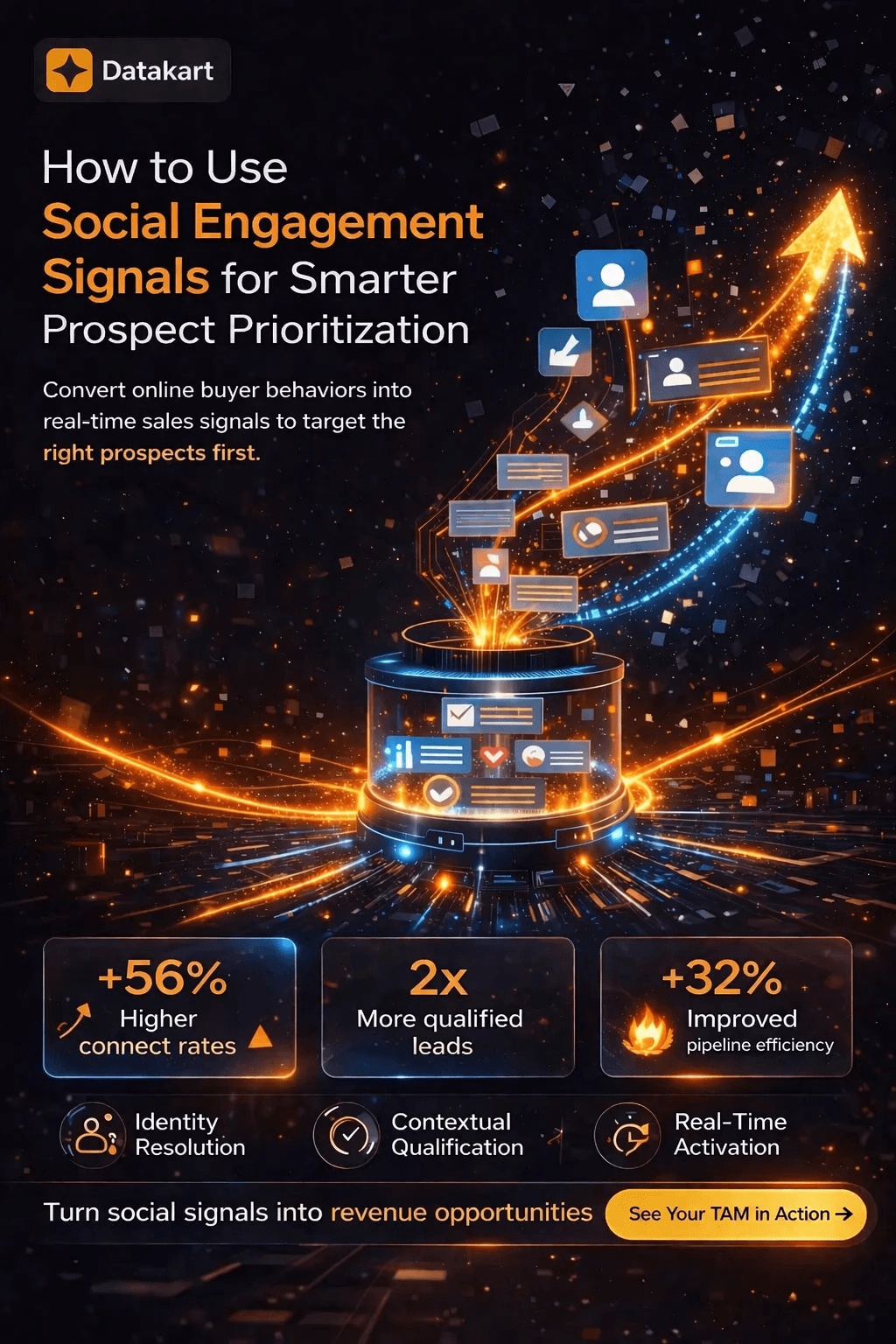
How to Use Social Engagement Signals for Smarter Prospect Prioritization
Stop wasting time on cold leads. Learn how social engagement signals and verified data reveal buying intent and improve prospect prioritization.
 March 19th, 2026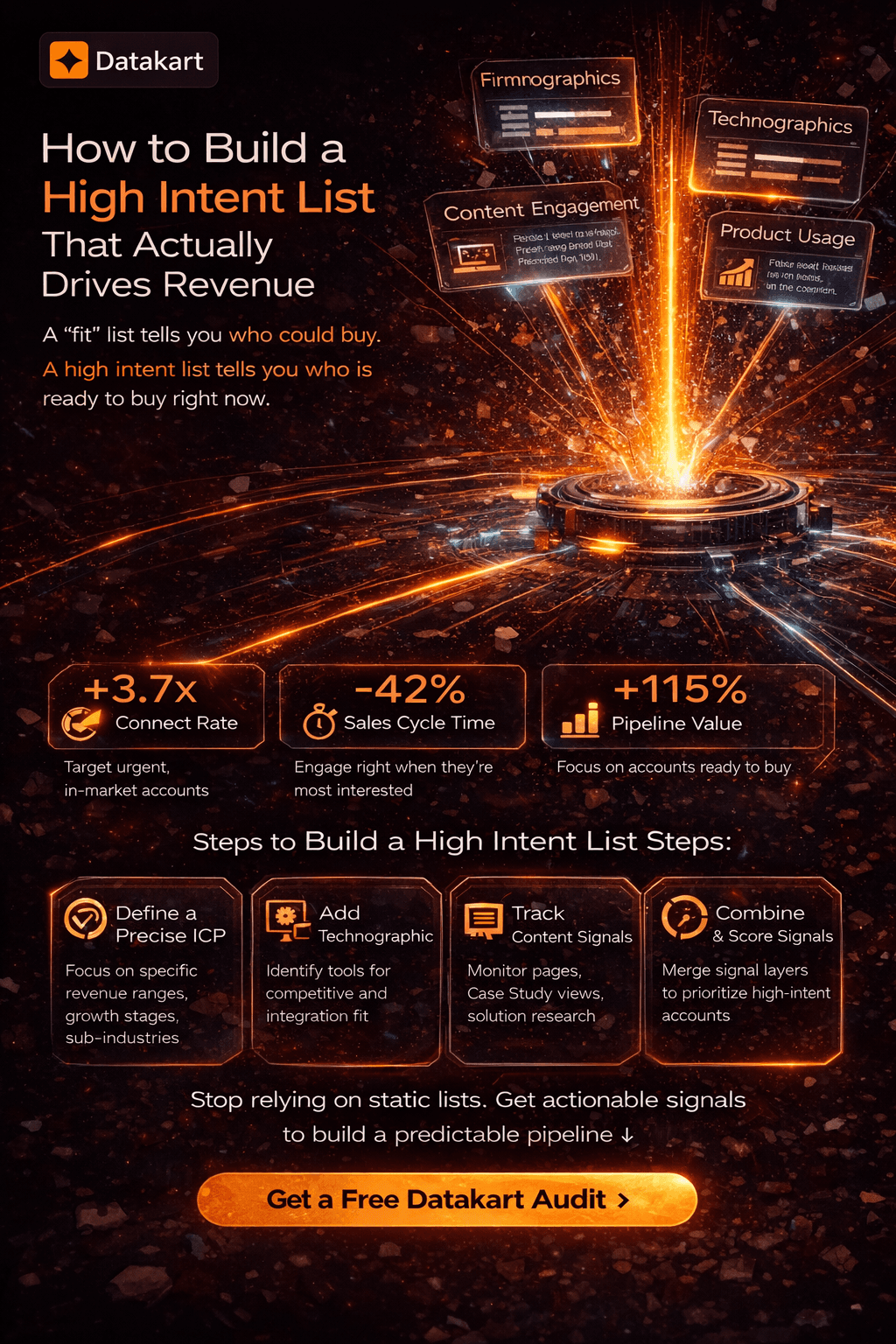
Stop wasting resources on stale data. Learn to build a high intent list using combined engagement, content, and product signals for a smarter GTM strategy.
Your GTM motion isn’t failing because of effort, it’s failing because of timing.
SDRs are reaching out too early, marketing is nurturing too late, and pipeline depends more on luck than precision.
The core issue is that most teams target accounts based on fit rather than intent.
A static list tells you who could buy.
A high intent list tells you who is ready to buy right now.
That distinction separates pipeline that converts from pipeline that stalls.
Most GTM teams still operate with outdated list-building approaches.
They purchase data, enrich it once, and push it into outbound sequences.
While this creates the illusion of coverage, it often produces noise rather than results.
Data Decays Faster Than You Think
Contacts change roles frequently. Companies restructure, titles evolve, and email addresses become outdated within months.
As a result, a significant portion of your list quickly becomes unusable.
Lack of Buying Context
Traditional lists provide firmographic data but fail to capture behavior.
You know who a contact is, but not what they are researching or planning.
Misallocated Sales Effort
High-value sales reps spend time qualifying cold accounts instead of engaging prospects already showing interest.
This inefficiency compounds across the entire team.
Weak Personalization
Without contextual data, personalization becomes superficial.
Messages reference basic attributes like company or role, but fail to address the actual trigger driving interest.
The outcome is predictable: low connect rates, poor conversion, and inefficient pipeline generation.
Modern GTM teams no longer rely on static lists. They build pipelines powered by real-time signals.
Instead of focusing solely on fit, they prioritize accounts actively demonstrating intent.
Rather than asking which companies match an Ideal Customer Profile, the focus shifts to identifying which of those companies are currently in-market.
Platforms like Datakart’s GTM intelligence platform enable this transition by combining fragmented data into a unified intelligence layer.
Key capabilities include:
Continuous Verification
Data is constantly refreshed and validated, ensuring accuracy and eliminating decay as a limiting factor.
Multi-Signal Aggregation
Multiple signal layers are combined to create a comprehensive view of intent:
• Firmographics (who they are)
• Technographics (what they use)
• Content signals (what they are researching)
• Engagement intent (how they interact)• Product signals (how they behave in your product)
Real-Time Prioritization
AI-driven systems surface accounts demonstrating active buying behavior, allowing teams to focus on opportunities that matter now.
This approach transforms GTM execution from reactive outreach to proactive engagement.
Creating a high intent list requires a structured approach built on layered signals.
The process begins with defining a precise Ideal Customer Profile. Instead of broad segments, leading teams specify attributes such as revenue range, growth stage, business model, and sub-industry.
Once ICP criteria are established, technographic data provides additional context. Understanding which tools a company uses helps identify competitive displacement opportunities, integration potential, and organizational maturity.
Content signals are then layered in to reveal problem awareness. Repeated visits to pricing pages, engagement with case studies, and interactions with solution pages indicate active research behavior.
Engagement intent adds another dimension. Webinar participation, email interactions, and social engagement demonstrate early-stage interest and signal potential buying activity.
For companies with product-led growth models, product signals become the strongest indicator. Feature adoption, usage spikes, team expansion, and visits to upgrade pages often reflect immediate buying readiness.
CTA: Want to see your TAM in action? Try Datakart’s Free Audit.
These signals must then be combined into a scoring framework. Individual signals provide limited insight, but when layered together, they create a clear picture of intent.
For example:
• ICP match indicates baseline fit
• Adding content engagement signals increases priority
• Combining product usage or multi-touch engagement identifies high-intent accounts
Finally, the system must operate dynamically. Signals should refresh continuously, contact data should be verified in real time, and prioritization should automatically update within CRM systems.
A high intent list is not a static dataset, it is a continuously evolving intelligence feed.
Consider a SaaS company targeting operations teams that struggled with low conversion despite high outreach volume.
Initially, the team relied on a static list of thousands of contacts and executed generic outreach sequences.
The results were underwhelming, with low connect rates, poor meeting quality, and inconsistent pipeline performance.
After adopting a signal-driven approach, the company significantly reduced its target list and focused only on accounts demonstrating multiple intent signals.
Outreach was aligned with real-time behavior rather than generic assumptions.
The impact was immediate.
• Connect rates increased by three to four times
• Meeting conversion rates improved significantly• Sales cycles shortened
The organization did not increase outreach volume. It improved targeting precision.
Several common mistakes limit the effectiveness of high intent list strategies.
Relying on a single signal often leads to inaccurate prioritization. Intent should be identified through patterns rather than isolated actions.
Ignoring data quality reduces effectiveness. Signals layered on inaccurate data create confusion and misdirection.
Misalignment between marketing and sales teams weakens execution. Both teams must operate on a shared signal framework.
Treating intent as static is another common error. Buying signals evolve quickly, and delayed action results in missed opportunities.
A modern GTM stack separates execution from intelligence.
CRM systems such as Salesforce or HubSpot act as the system of record.
Sales engagement platforms execute outreach campaigns.
The intelligence layer powers both systems.
Platforms like Datakart’s data intelligence platform combine signals, validate data, and prioritize accounts automatically.
Organizations evaluating this approach often review Datakart’s pricing and enrichment plans to understand how signal-driven intelligence integrates into their GTM strategy.
The most important shift in modern GTM is not better messaging—it is better timing.
A high intent list enables teams to engage prospects when they are already thinking about the problem you solve.
Instead of interrupting cold accounts, teams join active buying conversations.
This approach improves efficiency, increases conversion rates, and creates a more predictable pipeline.
In today’s market, precision always outperforms volume.
Ready to build a pipeline that actually converts?
Discover how real-time intent signals can transform your GTM performance. Book a 30-minute demo with the Datakart team and start targeting accounts that are ready to buy.
What is a high intent list?
A high intent list is a dynamic group of accounts that match your ICP and are actively demonstrating buying behavior through multiple combined signals.
What are the strongest intent signals?
Product usage patterns, pricing page visits, multi-user engagement, and repeated content interactions are among the most reliable indicators of intent.
How often should a high intent list be updated?
Ideally in real time. At a minimum, lists should refresh daily or weekly to remain actionable.
How is this different from MQLs?
MQLs are often triggered by single actions, whereas a high intent list is built using multiple combined signals, making it more predictive of actual buying behavior.
Stop wasting time on cold leads. Learn how social engagement signals and verified data reveal buying intent and improve prospect prioritization.
March 19th, 2026
Master intent data to engage prospects at the right moment, personalize outreach, and accelerate pipeline growth.
October 5th, 2025
Mid-market sales prospecting has fundamentally shifted. Discover the new playbook — from AI-assisted outreach and buying committee mapping to intent data and hyper-personalization — that top-performing teams are using to break through the noise.
February 26th, 2026