
Lead Enrichment Tools in 2025, Comparing the Top Platforms and Metrics That Matter
Build a reliable pipeline with real-time enrichment, validated data, and actionable buyer intent signals.
 October 2nd, 2025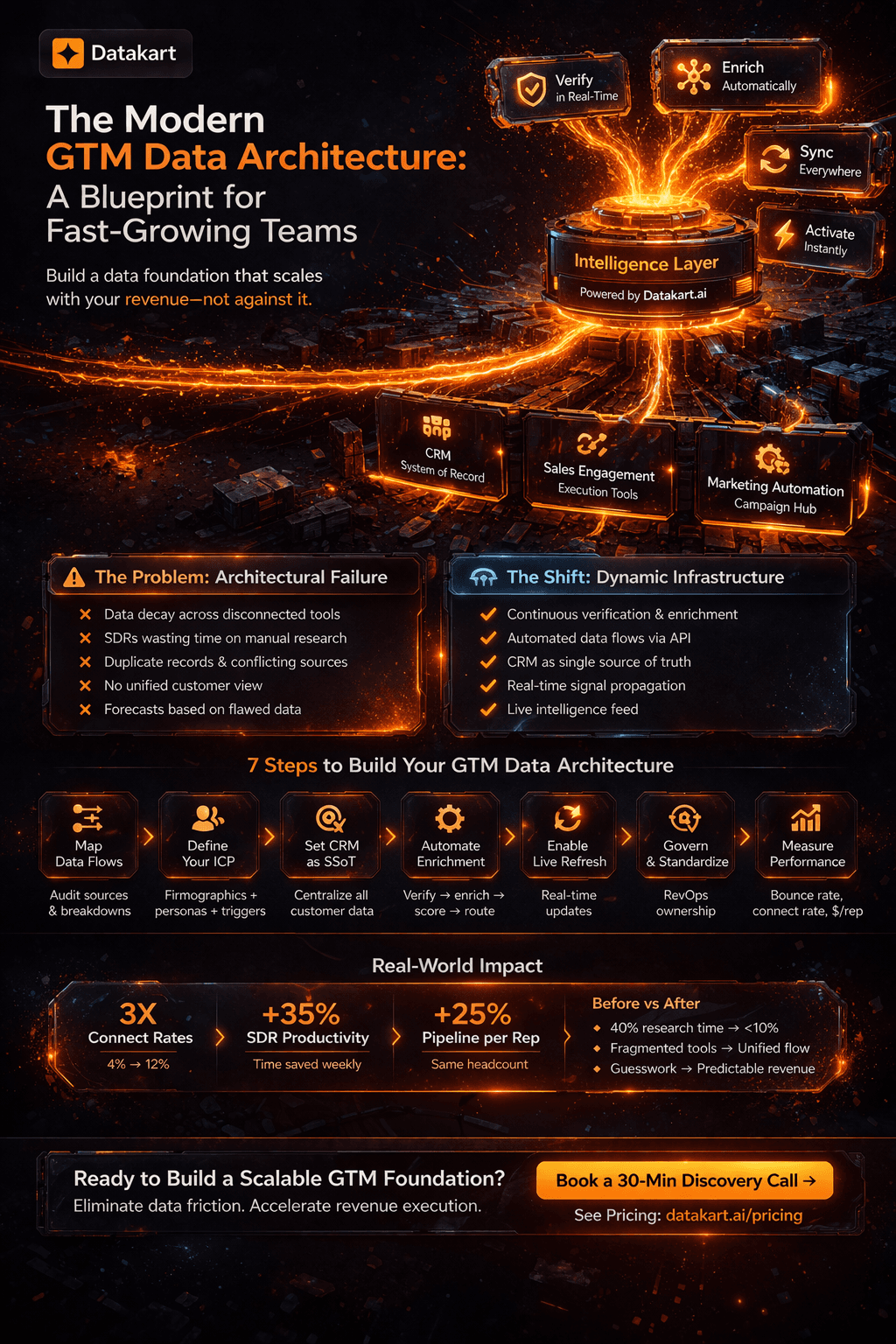
Stop fighting stale data. Learn to build a scalable GTM data architecture for your RevOps team with our step-by-step framework to unify data flows and drive growth.
Your GTM engine is not underperforming because of strategy.
It is underperforming because of infrastructure.
Most fast-growing teams hit a ceiling not due to lack of demand, but because their data foundation cannot scale with them. Systems do not communicate, records decay, and reps spend more time fixing data than using it.
This is where GTM data architecture becomes the difference between chaotic growth and predictable revenue.
A well-designed architecture does not just organize data. It orchestrates it.
Most GTM teams operate with a fragmented technology stack.
• CRM acting as a partial source of truth
• Marketing automation maintaining separate datasets
• Sales tools functioning independently
• Spreadsheets bridging critical gaps
This fragmentation creates systemic issues.
Data Decay Compounds Quickly
B2B data changes continuously. Roles shift, companies evolve, and contact details become outdated. Static datasets degrade faster than teams can maintain them.
Sales Productivity Declines
Sales representatives spend significant time validating data instead of engaging prospects. High-value talent is diverted to low-value activities.
No Unified Customer View
Each team operates with a different version of the customer, leading to misalignment and inefficient handoffs.
Personalization Breaks Down
Without accurate and enriched data, messaging becomes generic and ineffective.
Forecasting Becomes Unreliable
When CRM data cannot be trusted, pipeline visibility suffers. Decision-making becomes reactive rather than strategic.
These challenges are not isolated inefficiencies. They are symptoms of a broken data architecture.
Modern GTM teams treat data as a real-time system rather than a static asset.
Instead of relying on periodic uploads and manual fixes, they build architectures where data is continuously verified, automatically enriched, and instantly accessible across systems.
Platforms like Datakart’s GTM intelligence platform enable this transformation by acting as the intelligence layer across the entire GTM stack.
Key changes in this model include:
Upstream Data Accuracy
Data is verified before entering systems, preventing downstream errors and inefficiencies.
Automated Data Flows
Information moves seamlessly across tools through APIs and automated workflows.
Reliable CRM Systems
All teams operate from a single, validated source of truth, ensuring consistency across functions.
This is not incremental improvement. It is a structural transformation.
A scalable data architecture requires a structured approach built around clear data flows and governance.
The process begins by mapping current data flows. Identify where data originates, where it is stored, how it moves, and where breakdowns occur. This often reveals duplicate entry points, manual dependencies, and disconnected systems.
Next, define your Ideal Customer Profile and associated data requirements. Beyond firmographics, include technographics, personas, and trigger signals such as hiring activity or product usage. This determines the type of data required and how it should flow through your systems.
The CRM must then be established as the single source of truth. All records should originate or synchronize with the CRM, and all tools must integrate with it bidirectionally. Data ownership and governance should also be clearly defined at this stage.
Once the foundation is set, automated enrichment and verification workflows should be implemented. New records should be checked for duplication, enriched with relevant data, verified for accuracy, scored based on intent, and routed appropriately. This entire process must operate automatically.
CTA: Want to see your TAM in action? Try Datakart’s Free Audit.
Continuous data refresh cycles are critical. Systems must regularly re-verify contacts, detect job changes, and update intent and engagement signals. Data architecture should function as a live intelligence system rather than a static database.
Governance and ownership must also be established. RevOps teams typically manage data standards, field definitions, and rules for data entry. Consistency is essential to maintain system integrity over time.
Finally, success should be measured through business-impact metrics such as email bounce rates, connect rates, data completeness, SDR productivity, and pipeline generated per representative.
A mid-stage SaaS company faced stalled growth despite increasing headcount.
Their initial state included fragmented data systems, low connect rates below four percent, and SDR teams spending approximately 40 percent of their time on manual research.
After implementing a modern GTM data architecture, they introduced automated enrichment and verification workflows, unified their CRM as the single source of truth, and integrated real-time data flows through Datakart.
The results were substantial.
• Connect rates increased significantly
• SDR productivity improved by 35 percent
• Pipeline per representative grew by 25 percent
The improvement did not come from increased effort. It came from eliminating structural inefficiencies.
Several common pitfalls limit the effectiveness of GTM data architecture initiatives.
Adopting a tool-first approach without defining processes often increases complexity rather than solving core problems.
Treating data as a one-time problem leads to recurring issues. Data decay is continuous and must be addressed with ongoing systems.
Weak governance results in inconsistent data quality and system degradation over time.
Misalignment between sales, marketing, and RevOps reduces effectiveness. All teams must operate from shared definitions and data standards.
A modern GTM architecture is built on three foundational layers.
CRM systems such as Salesforce or HubSpot serve as the system of record.
The intelligence layer ensures data accuracy and enrichment.
Platforms like Datakart’s data intelligence platform verify, enrich, and unify data across systems.
Execution tools, including sales engagement and marketing automation platforms, activate this data for outreach and campaigns.
Organizations evaluating this approach often review Datakart’s pricing and enrichment plans to understand how data infrastructure integrates into their GTM stack.
The underlying principle is clear: clean data enables efficient execution, which drives better outcomes.
Every GTM strategy ultimately depends on execution.
Execution depends on data.
Without a strong GTM data architecture, even the best strategies break down at scale.
With the right architecture, teams benefit from faster execution, improved targeting, higher conversion rates, and more predictable pipeline generation.
This is not simply a backend improvement. It is a primary driver of growth.
Ready to build a scalable GTM foundation?
Discover how modern data architecture can transform your revenue engine. Book a 30-minute discovery call with the Datakart team and explore how intelligent data infrastructure supports growth.
What is GTM data architecture?
GTM data architecture refers to the system of tools, workflows, and governance that manage how customer and prospect data is collected, enriched, and utilized across sales, marketing, and RevOps teams.
Why is a single source of truth important?
A single source of truth ensures that all teams operate on consistent and accurate data, reducing misalignment and improving execution efficiency.
What does a modern enrichment stack include?
A modern stack typically includes a CRM, a data intelligence platform such as Datakart, and integrated execution tools connected through automated workflows.
How often should data be refreshed?
Data should be refreshed continuously. Real-time or near real-time verification is essential to maintain accuracy and relevance.
Build a reliable pipeline with real-time enrichment, validated data, and actionable buyer intent signals.
October 2nd, 2025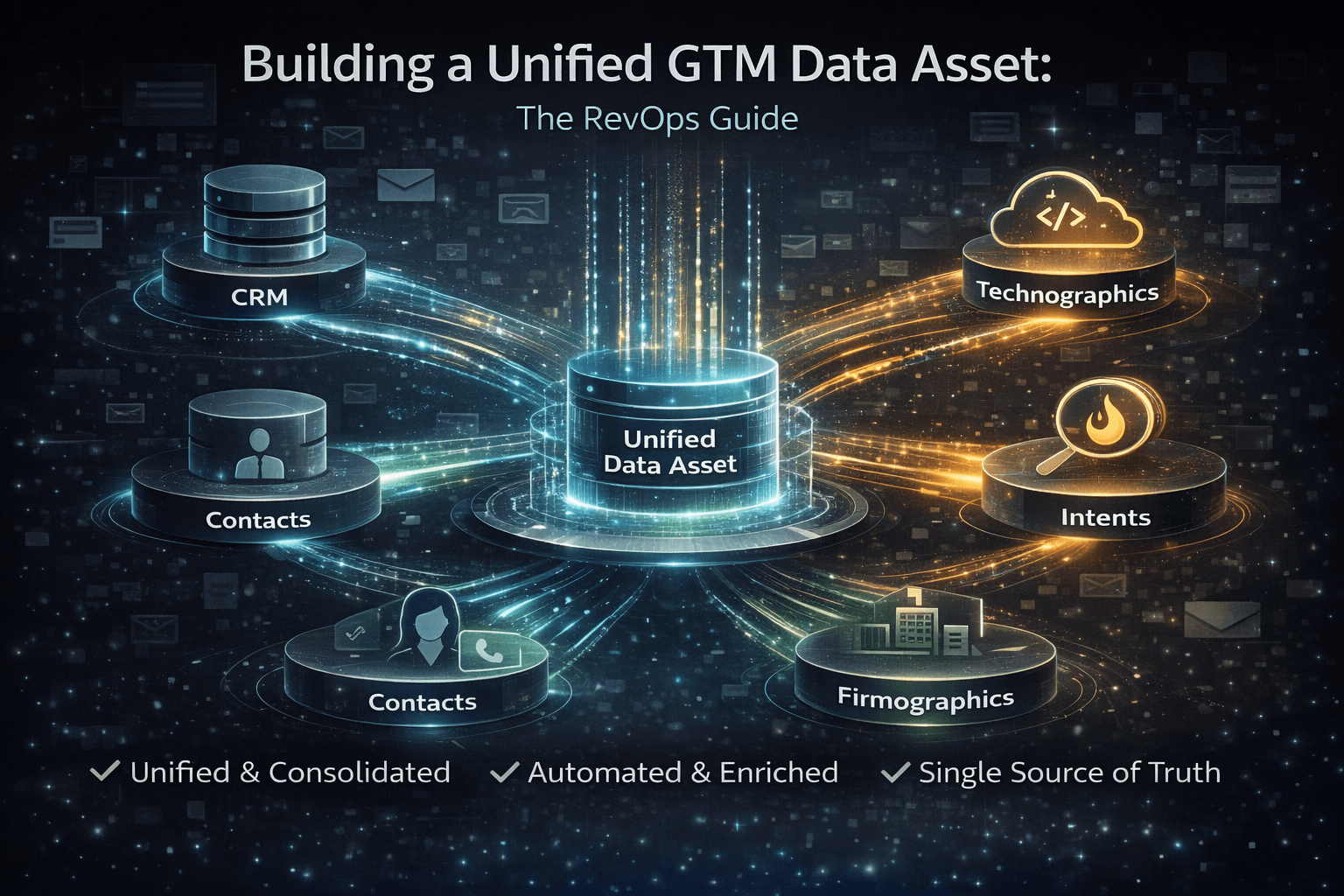
Stop struggling with data silos. Learn how to create a unified data asset by merging databases and automating your enrichment stack for better GTM.
January 20th, 2026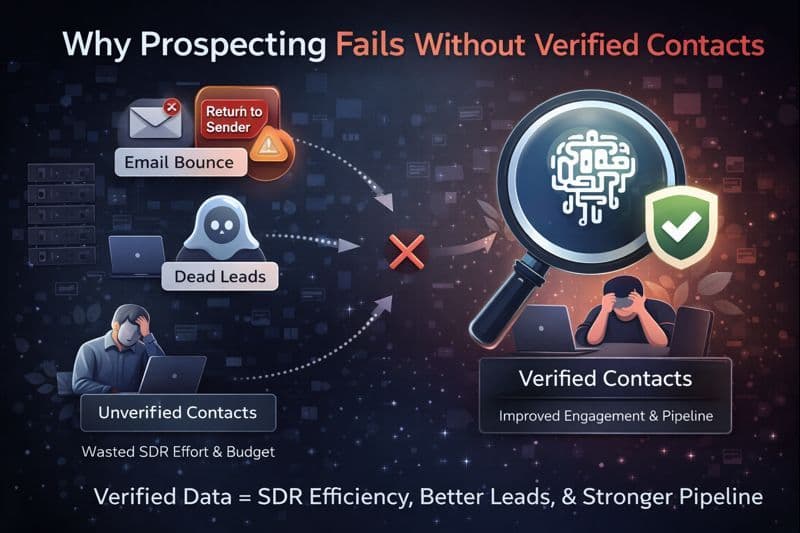
Stop wasting resources on dead leads. Discover how verified contacts improve SDR efficiency, outbound performance, and lead quality for B2B GTM teams.
January 20th, 2026